cpeditor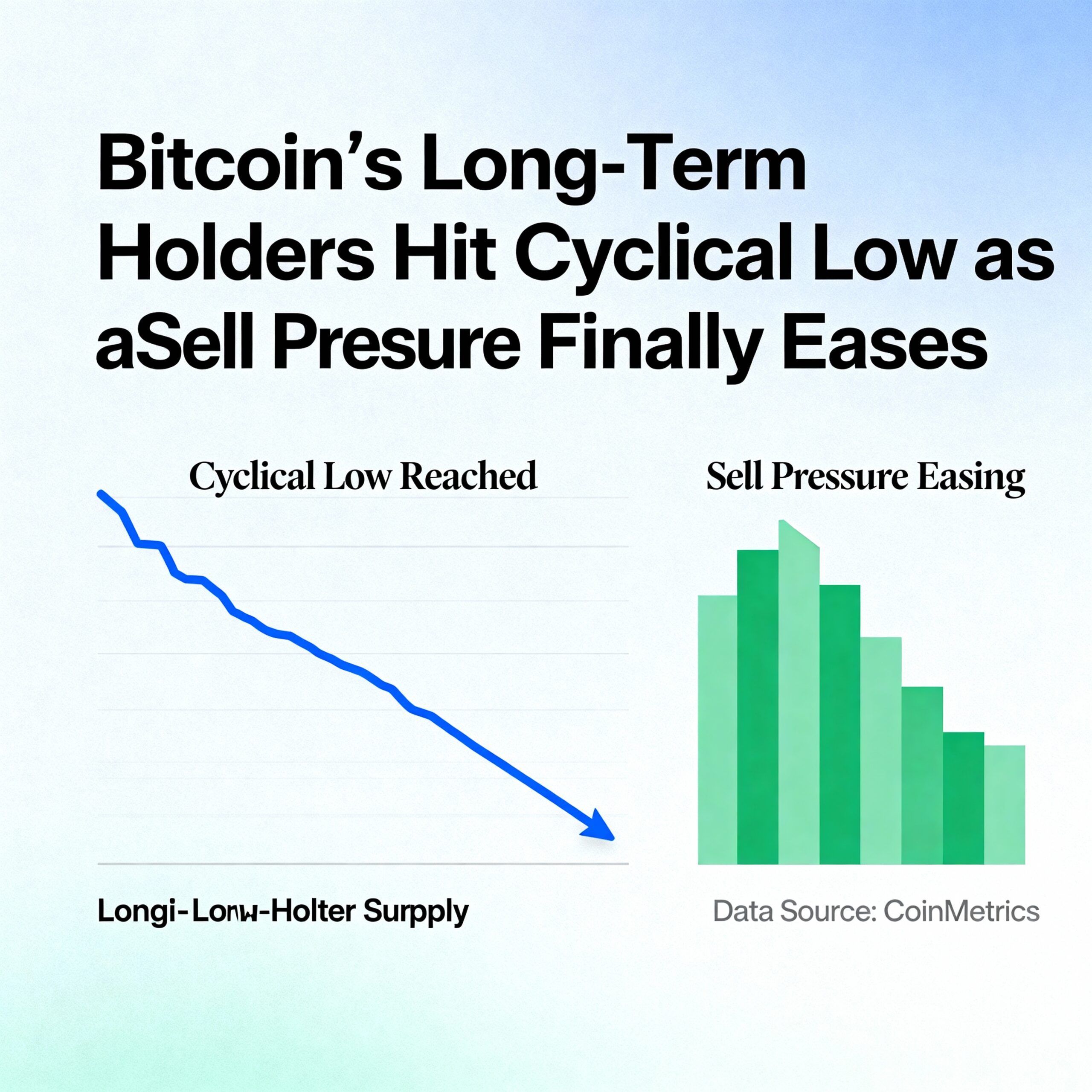
Bitcoin Long-Term Holder Supply Hits Cyclical Low as Selling Pressure Eases
Long-term holder supply in Bitcoin bottomed as the price dipped to $80,000, signaling that the wave of spot-driven selling may be approaching exhaustion. Since then, the cryptocurrency has rebounded to $90,000, roughly 15% higher from the recent low, suggesting that much of the selling pressure from the market’s correction has already played out.
Data shows that long-term holder (LTH) supply reached a cyclical low on Nov. 21, coinciding with Bitcoin’s $80,000 bottom. This follows a 36% peak-to-trough correction, highlighting that the market may be stabilizing as seasoned holders curb distribution.
Long-term holders—defined as entities holding Bitcoin for at least 155 days—typically see their supply increase as coins age from short-term holders. The recent stabilization and uptick in LTH supply point to a slowdown in distribution from these holders, reducing structural sell pressure and potentially supporting further price recovery.
Since July, long-term holders have trimmed their holdings from 14,769,512 BTC to 14,330,128 BTC in November. The two prior troughs in LTH supply occurred in April 2024 and March 2025. In April 2024, the decline came shortly after Bitcoin reached its all-time high of $73,000, indicating distribution into strength. The March 2025 low coincided with the correction driven by Trump-era tariff concerns, with Bitcoin bottoming at approximately $76,000 in April.
Historically, long-term holder supply tends to drop sharply during retail-driven mania phases at cycle peaks, most notably in 2017 and 2021. This cycle, however, shows a more measured pattern: steadier ebbs and flows rather than a dramatic blow-off top followed by aggressive distribution. Analysts note that this evolution in market structure and holder behavior challenges the traditional four-year cycle narrative, reflecting a shift in on-chain dynamics.