cpeditor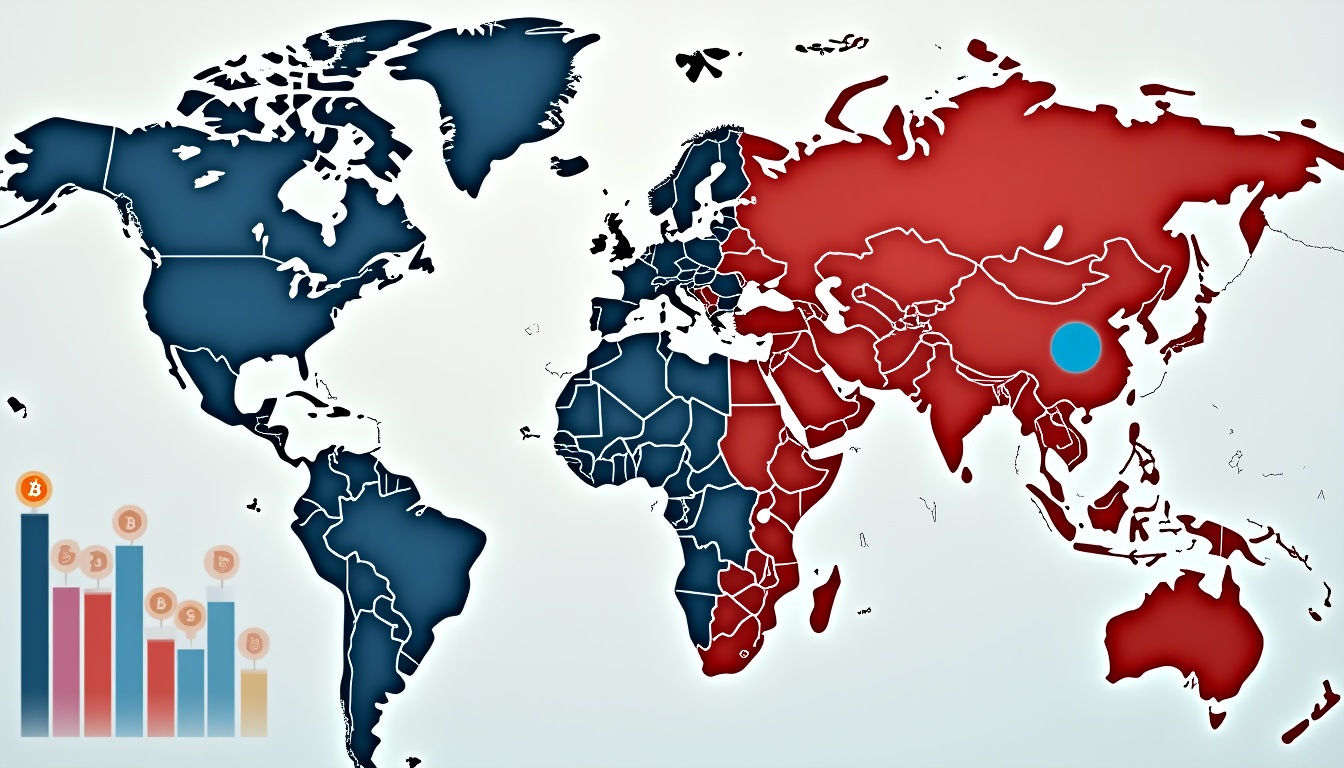
Asian Market Share in Crypto Trading Surges as U.S. Influence Recedes Below 45%
The global crypto market is witnessing a structural shift in trading behavior, with Asia gaining significant ground in spot volumes across major digital assets, while U.S. market share dips to its lowest level in months.
According to data from crypto prime brokerage FalconX, the U.S. now accounts for less than 45% of spot trading in Bitcoin (BTC), Ether (ETH), and Solana (SOL), based on a 30-day moving average. That’s a marked decline from the post-election peak of over 55% in early 2025, and the lowest reading since Donald Trump’s pro-crypto victory last November.
Meanwhile, Asian trading hours have climbed to nearly 30% of global volume, highlighting a redistribution of liquidity across time zones. European hours continue to contribute the remainder.
“This regional rebalancing could reflect increasing participation from non-U.S. investors or a pivot by American market participants toward derivatives or ETF products,” said David Lawant, Head of Research at FalconX.
Despite the regional reshuffling, digital assets have rallied sharply. From early April lows, BTC has gained 40%, ETH is up 87%, and SOL has climbed 68%, indicating robust price momentum even as U.S. activity moderates.
ETF Demand Offsets Weak Spot Volume
One key development is the decoupling of price action from spot volume. BTC daily spot trading remains below $10 billion, down from $15 billion averages seen shortly after the U.S. election, signaling a more concentrated or passive investor base.
However, spot bitcoin ETFs are rapidly filling the gap. In just two months, their share of global spot BTC trading has risen from 25% to 45%, according to FalconX. These flows are largely directional, representing high-conviction positioning rather than hedged arbitrage strategies.
Since launching in January 2024, the 11 U.S.-listed spot bitcoin ETFs have amassed $44 billion in cumulative inflows, with BlackRock’s IBIT drawing $6.35 billion in May alone—its strongest month since the start of the year.
“Institutional allocation via ETFs is emerging as the dominant driver of BTC demand in this phase of the cycle,” Lawant noted. “As long as geopolitical concerns and bond market stress persist, ETFs are well-positioned to absorb new flows.”