cpeditor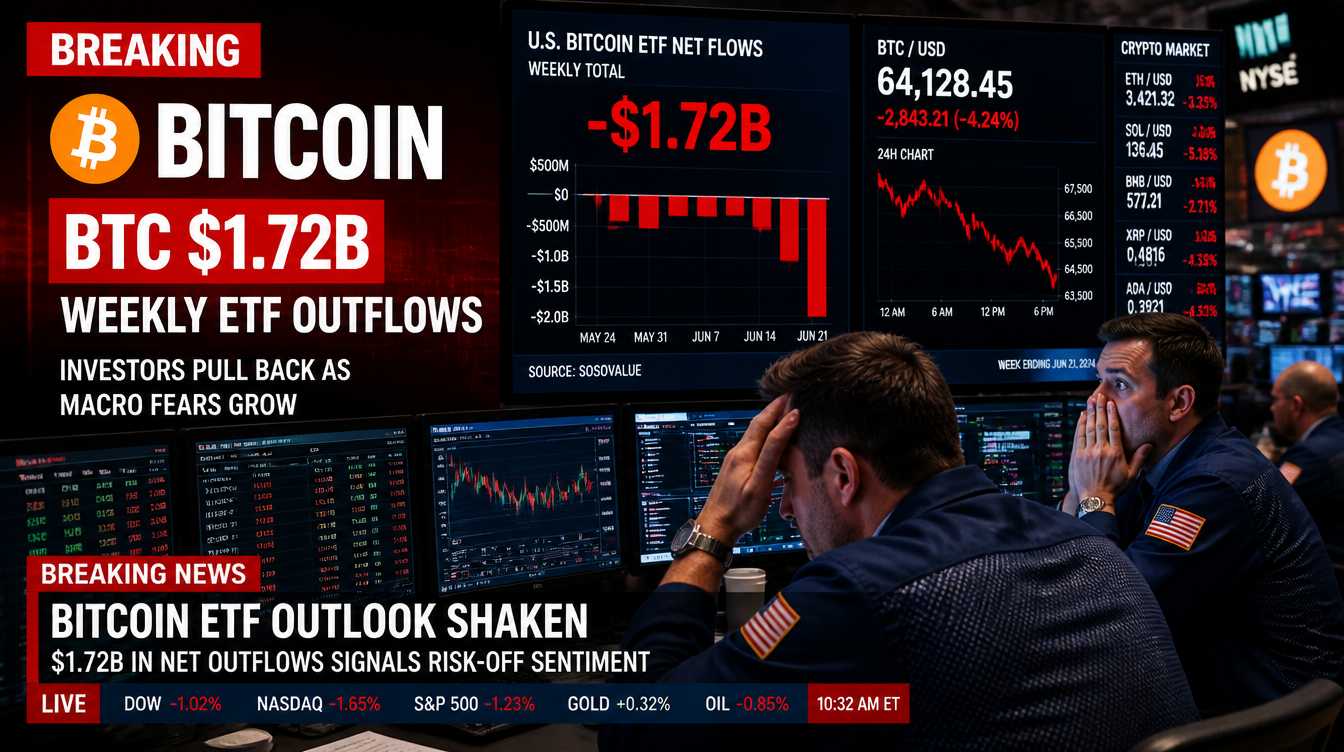
Here’s a fresh rewrite with a slightly more narrative, newsroom-style flow:
Bitcoin ETFs See $1.72B Weekly Outflows Amid Mounting Macro Pressure
U.S. spot Bitcoin ETFs recorded $1.72 billion in net outflows for the week ending June 6, 2026, marking the heaviest weekly withdrawal since April 2025. The sharp pullback coincided with Bitcoin dropping nearly 18%—its steepest weekly decline of the year—before recovering modestly by 1.5% to trade near $63,100.
The scale of the outflows reflects a broader convergence of macro and geopolitical pressures. Escalating tensions between Iran and Israel pushed oil prices higher by over 5%, while stronger-than-expected U.S. employment data revived concerns that the Federal Reserve could maintain a tighter policy stance for longer. At the same time, institutional investors have increasingly rotated capital into AI-driven equities, reducing exposure to crypto assets across diversified portfolios.
The narrative is now evolving. Rather than focusing solely on the magnitude of the ETF withdrawals, market participants are assessing whether the selling wave is nearing its end—or if it signals a more lasting shift in institutional positioning toward Bitcoin.
Breaking Down ETF Flows and Market Drivers
Figures from SoSoValue show that the $1.72 billion outflow extends a four-week streak of redemptions, pushing cumulative withdrawals to $5.4 billion. This has reduced total spot Bitcoin ETF assets under management from approximately $104 billion to $94 billion.
A significant portion of the selling pressure has been concentrated in BlackRock’s IBIT, which accounted for $440.3 million of the $483.8 million in net outflows on June 1 alone. Given IBIT’s role as a primary gateway for institutional Bitcoin exposure since early 2024, its movements are widely viewed as a key indicator of large-scale investor sentiment.
The macro backdrop has played a central role in driving these flows. Rising Treasury yields, persistent inflation concerns, and diminishing expectations for near-term rate cuts have weighed heavily on non-yielding assets like Bitcoin. As a result, institutions have opted to reduce exposure through ETFs, which offer the most efficient liquidity for portfolio adjustments.
Friday’s stronger-than-expected nonfarm payrolls data further reinforced the “higher-for-longer” rate narrative, adding additional pressure to crypto markets.
Analysts at Galaxy Research suggest the ongoing outflows represent a broader portfolio reallocation rather than short-term positioning, signaling a more structural shift in institutional capital flows.
Meanwhile, continued interest in AI-related equities—including Nvidia, Marvell, and Micron—has provided alternative high-growth opportunities for investors. This capital rotation, combined with elevated yields, has remained a consistent headwind for Bitcoin throughout the current ETF outflow cycle.