cpeditor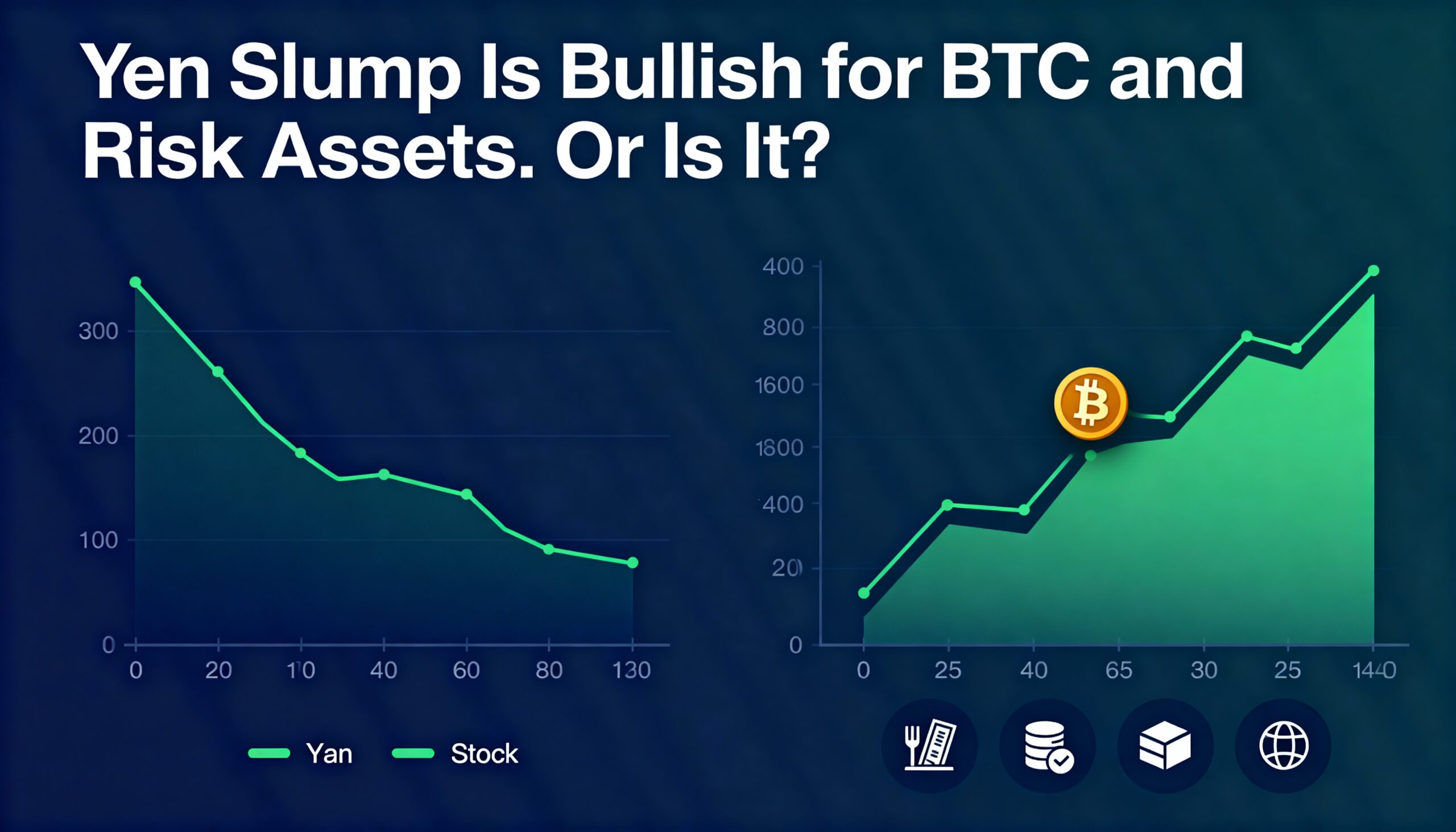
The Japanese yen continues to slide, trading near 157.20 per U.S. dollar—an unusually large move for a major currency—raising expectations that the Bank of Japan may soon intervene to slow the decline.
Why does this matter for crypto and broader risk assets? Historically, yen weakness has aligned with risk-on sentiment through the well-known yen carry trade. Investors borrow yen at low rates, convert it to higher-yielding currencies, and deploy the capital into risk assets. The weaker the yen falls, the more profitable these carry trades become, reinforcing the cycle.
When the yen strengthens, the dynamic reverses. Higher repayment costs typically dampen carry trades and signal market-wide risk aversion. During the August 2024 sell-off, for example, bitcoin dropped from about $65,000 to $50,000 after the BOJ raised rates for the first time in ten years, pushing the yen higher and triggering unwinds.
Given that backdrop, the yen’s latest tumble might appear bullish for BTC. The BOJ’s rate is just 0.5% compared with 4.75% in the U.S., creating an enormous yield gap that classically fuels carry flows. Reports even show Japanese retail investors chasing high-yield currencies like the Turkish lira.
But Japan’s macro backdrop has shifted. Mounting fiscal pressures mean the yen no longer offers the stable foundation that once made it a favored funding currency. With public debt sitting near 240% of GDP—and more borrowing on the way under Prime Minister Sanae Takaichi’s expansionary fiscal agenda—the currency is increasingly trading as a proxy for fiscal stress rather than risk appetite.
These strains are showing up across Japan’s bond markets. Despite years of ultra-low yields, the 10-year JGB now sits at 1.84%, the highest since 2008. Longer-dated yields are also at multi-decade highs. Yet the yen keeps weakening, breaking the long-standing positive correlation between yields and the exchange rate. As analysts note, fiscal concerns have overtaken traditional macro signals.
Japan is caught in a bind: allowing yields to rise risks a fiscal crisis, but capping rates risks a deeper yen spiral and rising imported inflation. As economist Robin Brooks summarized: “If Japan stabilizes the yen by letting yields rise, there’s a fiscal crisis. If it keeps rates low, the yen goes back into a devaluation spiral. Too much debt is a killer.”
The implication for traders is clear: yen volatility is likely to stay elevated, undermining its longtime status as both a haven and a reliable funding currency.
That shifts attention to alternatives. The Swiss franc, according to Bannockburn Global Forex’s Marc Chandler, is increasingly attractive as a carry vehicle. Switzerland’s benchmark rate is 0%, and its 10-year yield sits near 0.09%—the lowest among developed markets.
As a result, BTC traders may find the CHF, not the JPY, emerging as a more reliable barometer for global risk appetite.