cpeditor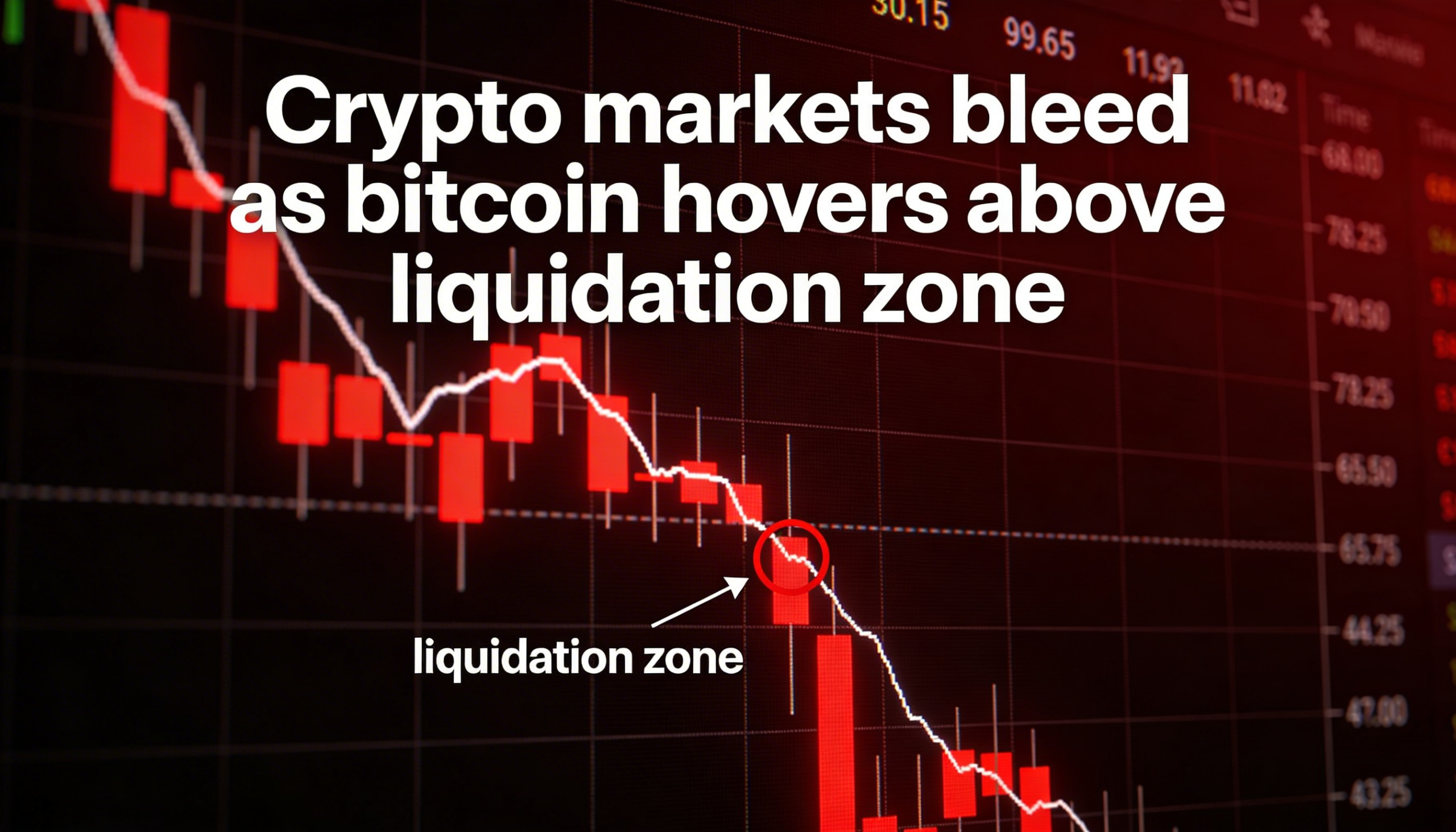
Bitcoin extended its pullback for a fourth consecutive day, sliding toward $63,000 as a stronger U.S. dollar and softer equity markets pressured risk assets worldwide. Traders caution that a clear breakdown below $60,000 could unleash fresh liquidations and open the path toward $52,500, a major support level that has held since 2021.
BTC fell to roughly $63,100, its lowest mark since the Feb. 6 dip near $60,200, according to CoinDesk data. The decline coincided with a 0.5% climb in the dollar index (DXY) since Monday’s Asian session and renewed weakness in U.S. stocks, reinforcing a broader risk-off tone.
Bitcoin is down 2.1% since midnight UTC and off 4.7% over the past 24 hours. Market participants warn that a sustained move beneath $60,000 would likely trigger another cascade of forced selling from leveraged traders.
Altcoins Follow Lower
Losses were widespread across the altcoin market. Bitcoin Cash dropped 11.5% in the past 24 hours, while Sui, Jupiter and World Liberty Financial each declined more than 2%, highlighting broad-based selling pressure.
Analysts described the market structure as a gradual “slow bleed,” a pattern often seen in prolonged downturns. However, technical indicators suggest the market may be nearing short-term exhaustion. The relative strength index (RSI) across major tokens has moved into oversold territory, pointing to the potential for a rebound if buyers defend support in the low $60,000 range.
Derivatives Markets Signal Deleveraging
Futures and options activity underscores a defensive shift in positioning:
- Aggregate notional open interest in crypto futures fell more than 4% to $92.5 billion, the lowest level since April 2025, indicating sustained deleveraging.
- Roughly $360 million in leveraged positions were liquidated over the past 24 hours, with long positions accounting for over 90% of forced closures on exchanges including BitMEX and Bitfinex.
- Despite the broader reduction in leverage, global open interest in bitcoin futures climbed to 690,890 BTC, its highest since Feb. 6, suggesting some traders are adding short exposure in anticipation of further downside.
- Funding rates for perpetual futures tied to major tokens remain negative, signaling a bearish tilt. Contracts linked to TRON show funding rates near -35%, indicating increasingly crowded short positioning.
- Thirty-day implied volatility for bitcoin and ether has risen to two-week highs, reflecting renewed market anxiety.
- On Deribit, put options on bitcoin and ether are trading at a volatility premium of more than 10 points over calls through late-March expiries, underscoring elevated demand for downside protection. Block trades included put spreads and straddles — strategies aimed at either hedging losses or capitalizing on rising volatility.
DeFi Struggles as Capital Rotates
Outside a few isolated outperformers, bullish catalysts remain limited. AI-focused token Pippin has been a rare bright spot, gaining 7.7% in the past 24 hours and doubling since the start of the year.
In decentralized finance, total value locked (TVL) has declined less sharply than token prices, suggesting investors are shifting into stablecoins rather than withdrawing entirely. Still, DeFi-linked tokens continue to lag. CoinDesk’s DeFi Select Index (DFX) has fallen 34.8% year-to-date, making it the worst-performing major crypto benchmark so far in 2026.
With macro headwinds intensifying and leverage steadily unwinding, the market’s immediate focus remains fixed on the $60,000 level. Whether that support holds could determine if bitcoin stabilizes — or faces a sharper leg lower in the weeks ahead.