cpeditor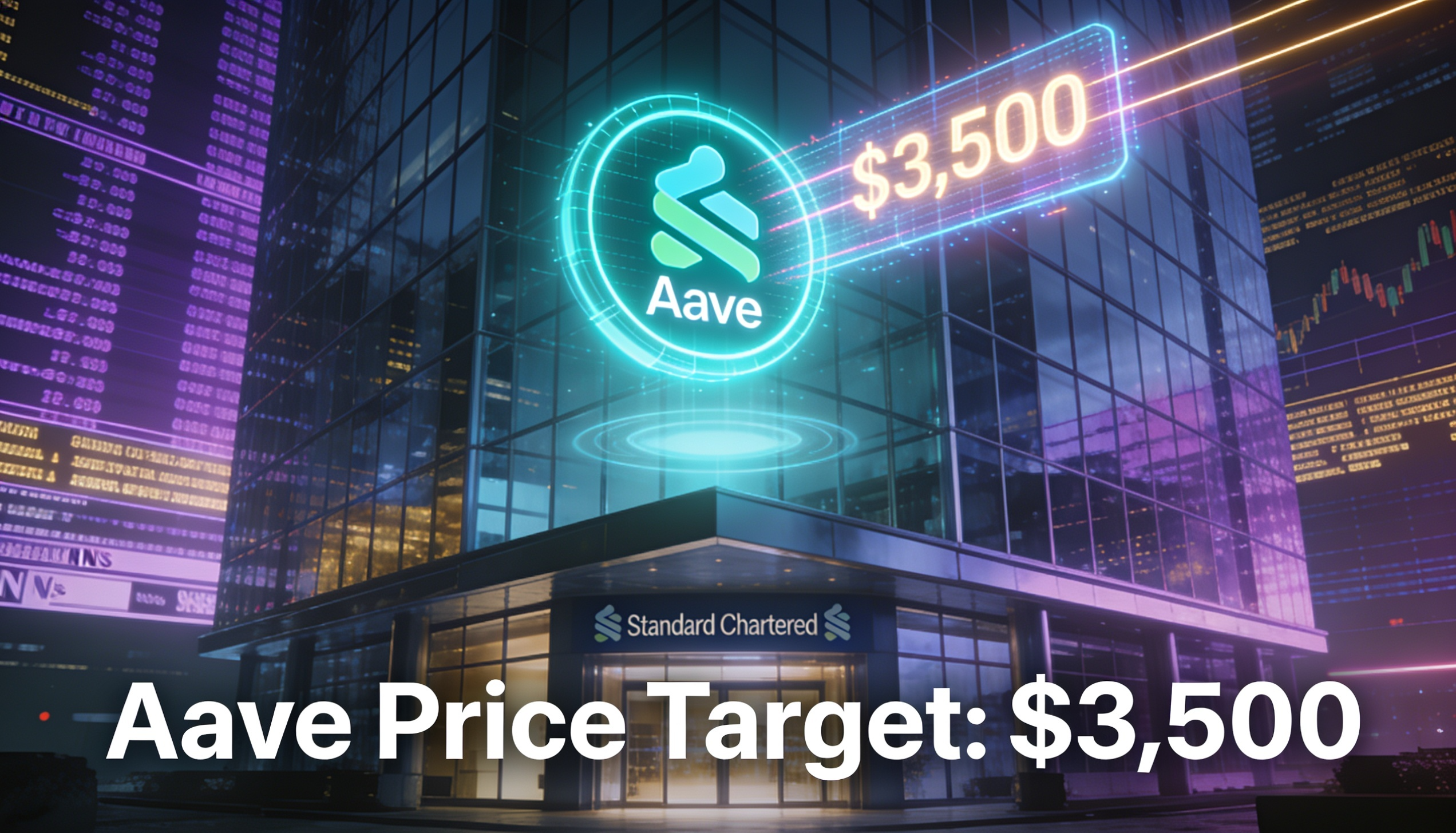
Standard Chartered’s Geoff Kendrick has assigned a $3,500 price target to AAVE by 2030, arguing that its dominance in DeFi lending and the accelerating growth of tokenized real-world assets (RWAs) could drive returns of roughly 50x.
Kendrick initiated coverage on June 25, 2026, when AAVE was trading near $70. The token has since gained about 25%, recently hovering around $92 and rising 4.2% on the day—standing out as one of the few large-cap cryptocurrencies in positive territory. On the day the report was released, AAVE surged approximately 15%, according to Binance Square.
Rather than a simple bullish call, Kendrick’s thesis centers on structural shifts within crypto markets. He argues that DeFi lending is entering a phase where institutional capital and tokenized RWAs increasingly converge on protocols that already dominate on-chain credit activity.
Aave’s Growth Path and DeFi Thesis
Kendrick outlines a stepwise valuation path: $180 by end-2026, $600 by 2027, $1,200 by 2028, $2,200 by 2029, and $3,500 by 2030.
This outlook is underpinned by three key macro assumptions: tokenized assets deployed in DeFi could expand 37x to $2.7 trillion by 2030; stablecoin supply may reach $2 trillion; and RWAs could grow from roughly 3.5% to 30% of overall DeFi activity.
He characterizes Aave as “an on-chain bank” that operates without employees or centralized decision-making, emphasizing that its valuation is driven by its structural role rather than short-term token performance.
At the time of the report, Aave controlled 61.5% of active DeFi loans and 52.4% of total value locked (TVL) in decentralized lending, according to Standard Chartered. Separately, Boston Consulting Group estimates tokenized illiquid assets could hit $16 trillion by 2030, reinforcing the broader backdrop for RWAs.
Institutional adoption is already emerging, highlighted by JPMorgan’s move to file for a second tokenized fund on Ethereum—signaling growing interest in on-chain collateral systems like Aave.
KelpDAO Exploit: Shock or Setup?
Kendrick’s report followed the April 2026 KelpDAO exploit, where a failure in its rsETH bridge enabled attackers to mint roughly $290 million in tokens, which were then used as collateral on Aave.
The incident exposed Aave to potential losses of around $230 million. Deposits fell sharply from $44 billion to $23 billion, while its share of DeFi lending deposits dropped from about 59% to 38%.
However, Aave’s core smart contracts were not breached. The vulnerability stemmed from KelpDAO’s infrastructure, highlighting a recurring DeFi risk where external layers fail while core protocols remain intact.
A trader cited by Forbes described the episode as exposing “the fragility of the entire system,” reflecting broader concerns about interconnected smart-contract risks.
Kendrick, however, views the event as a cyclical bottom rather than structural damage. He noted that capital has begun returning, with TVL stabilizing above $20 billion. Current TVL stands at $12.4 billion, down from a peak of $75 billion in late 2025.
Aave’s Safety Module allows staked AAVE to be slashed in extreme scenarios to recapitalize the system, supported by audits from firms including Trail of Bits and OpenZeppelin.
Bull Case, Risks, and Macro Outlook
For AAVE to reach $3,500, several conditions must align: RWA tokenization needs to scale toward a 30% share of DeFi, stablecoin supply must approach $2 trillion, and Aave must maintain its market leadership amid competition and ongoing upgrades like Aave V3.
Key risks include stricter regulation in the US or Europe, persistent smart-contract vulnerabilities, or slower adoption of RWAs within DeFi. Ultimately, the success of lending protocols will depend on collateral quality and system security rather than token momentum alone.
Kendrick also expects Bitcoin to reach $100,000 by the end of 2026 and Ethereum to recover to $4,000. Longer term, he projects Bitcoin at $500,000 and Ethereum at $40,000 by 2030, while maintaining that AAVE will outperform both on a percentage basis.
“The window for DeFi protocols to capture a meaningful share of the digital asset value chain is opening,” Kendrick said. “This is where the next wave of generational wealth is likely to emerge.”