cpeditor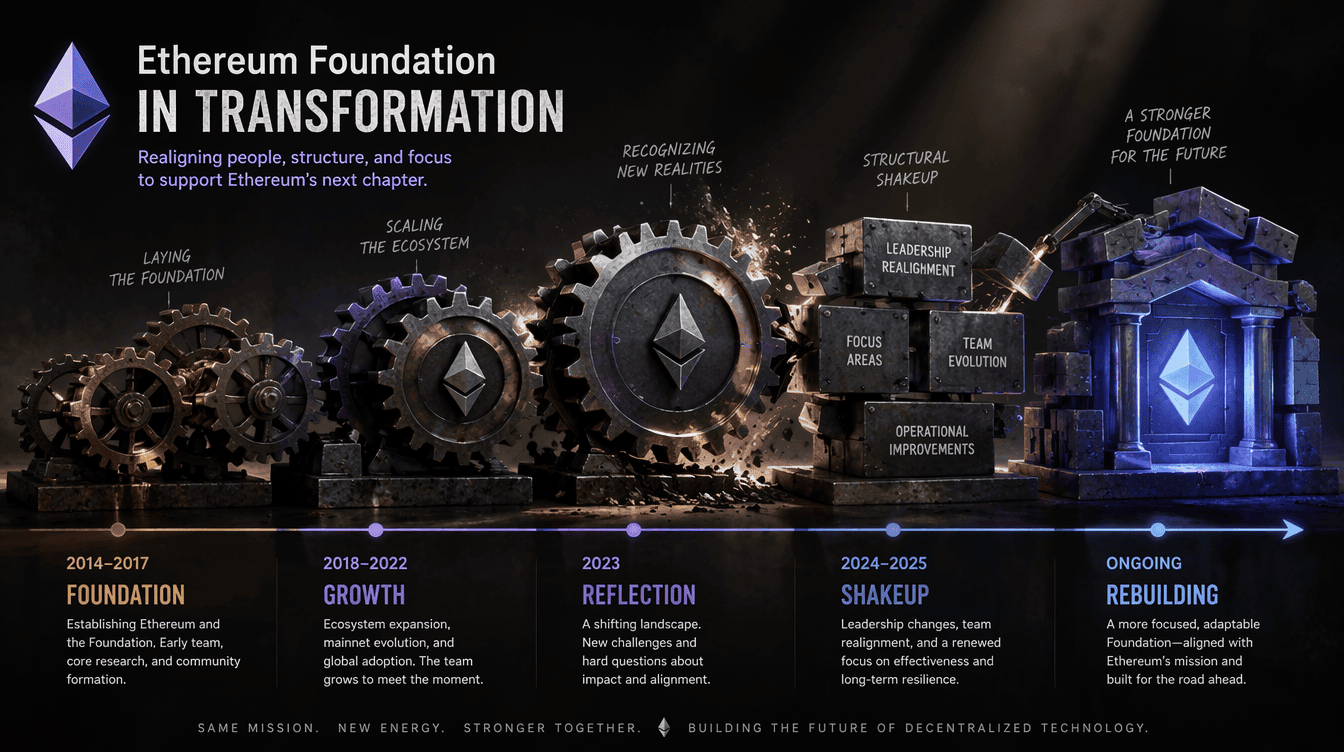
Here’s a fresh, concise rewrite with a slightly sharper tone:
In this week’s Protocol Newsletter, we map out the sequence of events that has reshaped the Ethereum Foundation over the past year.
The foundation entered 2026 under intensifying scrutiny. Developers, investors, and leading community voices had spent months criticizing its slow execution, governance structure, and technical direction. A common concern was that Ethereum’s roadmap had become overly focused on layer-2 scaling, while core base-layer improvements were being sidelined.
The first major shift came in February, when co-executive director Tomasz Stańczak stepped down after helping oversee early restructuring efforts. Soon after, the foundation released a revised mandate that narrowed its role within the ecosystem. Built around the CROPS principles—censorship resistance, resilience, openness, privacy, and security—the new direction repositioned the foundation as a long-term steward rather than the ecosystem’s central builder.
That leadership change was followed by a wave of exits. Over the next few months, nine senior leaders, researchers, and executives left the organization—one of the largest turnover periods in its history. While the departures sparked uncertainty, leadership framed them as part of a broader organizational reset, not a decline.
The reset accelerated in June. Co-executive director Hsiao-Wei Wang resigned, and days later the foundation unveiled its most sweeping overhaul yet. Roughly 20% of its workforce—54 roles—were cut, and its annual budget was reduced by about 40% to create a leaner, more sustainable structure. Remaining staff were reorganized into five core teams focused on areas where the foundation believes it has a unique role.
At the same time, new entities began taking over responsibilities once handled internally. ETHLabs launched with support from major ETH treasury firms to drive research, coordination, and product development. In July, Ethereum Institutional was introduced to support enterprises, asset managers, and nonprofits through research, education, and standards. Shortly after, EthSystems emerged as a for-profit venture focused on building privacy-preserving infrastructure for institutional users.
Taken together, the events of 2026 mark the most significant transformation in the foundation’s history. What began as community criticism over governance and priorities has resulted in a smaller, more focused organization, new leadership, a clearer mandate, and an ecosystem increasingly driven by independent groups advancing research, adoption, and protocol development.