cpeditor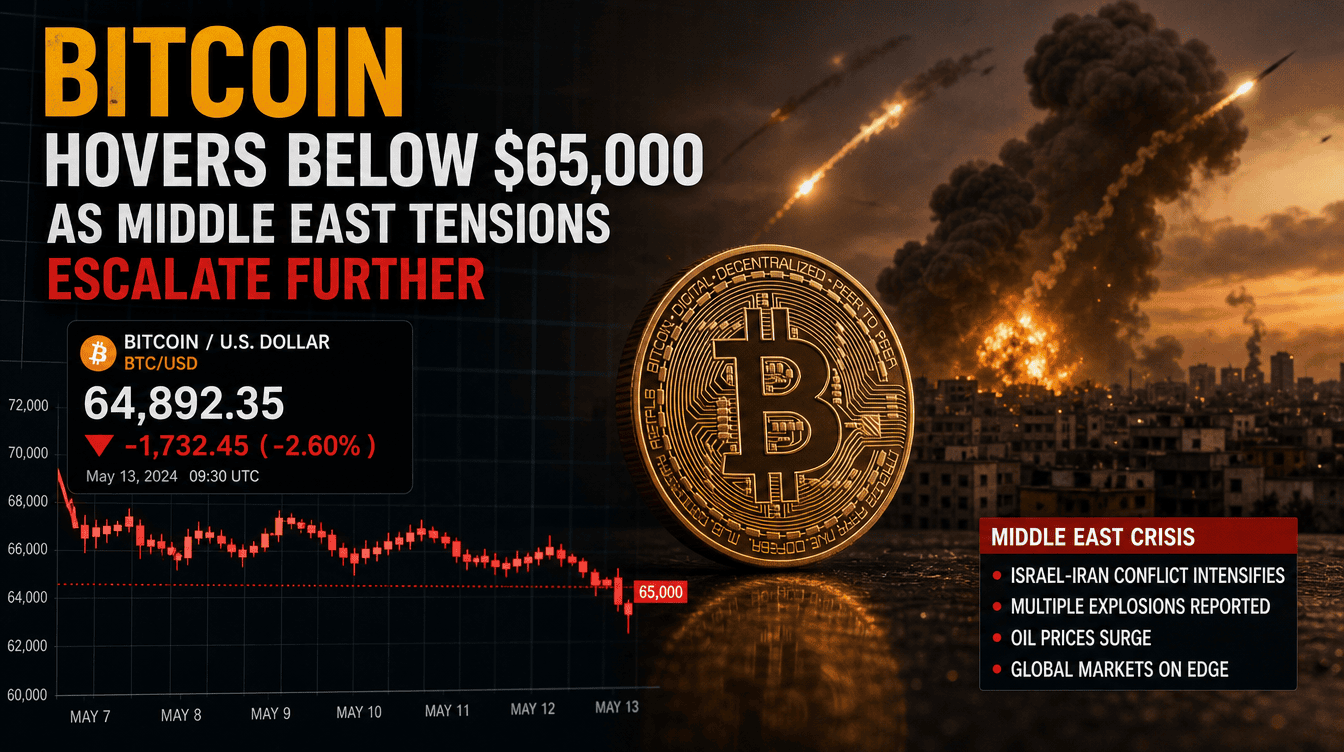
Bitcoin remained stuck below the $65,000 threshold on Friday as traders assessed increasing geopolitical risks, higher energy prices, and upcoming U.S. economic indicators.
BTC traded close to $64,700, with almost no change over the last 24 hours, while the CoinDesk 20 (CD20) index declined slightly by 0.2% during the same period.
Oil markets faced renewed pressure as Brent crude surpassed $83 per barrel after Iran-backed Houthi forces in Yemen launched an attack against Saudi Arabia, adding to concerns over escalating tensions in the Middle East.
Treasury yields edged lower but continued to stay elevated, with the 10-year U.S. Treasury yield holding around 4.67%. Fidelity global macro director Jurrien Timmer previously cautioned that historical market behavior suggests conditions often become challenging when yields remain above 4.5%.
A prolonged rise in crude prices could worsen inflation concerns, while elevated bond yields may further tighten financial conditions. These factors could reduce expectations for near-term Federal Reserve easing and weigh on Bitcoin and other risk-sensitive assets.
Gold continued its recovery as investors turned toward safer assets amid uncertainty, gaining 1.5% to trade around $4,300 per ounce.
Crypto Derivatives Overview
Futures traders turn cautious:
The crypto futures market’s long-short taker ratio moved back toward neutral after showing stronger bullish positioning on Thursday, indicating traders are taking a more defensive approach ahead of the U.S. payrolls data.
CC token sees bearish positioning increase:
Canton Network’s CC token dropped 13% over the past day, while futures open interest rose by more than 5%. The combination suggests continued bearish pressure, with negative open-interest-adjusted cumulative volume delta (CVD) showing that traders are using market orders to establish short positions.
Open interest shifts:
DOGE, XRP, and SUI recorded growth in open interest, while SHIB saw a decline.
CVD points to weak momentum:
The cumulative volume delta indicator continues to reflect selling pressure across much of the crypto market. Most major assets recorded negative CVD readings, with ADA, HBAR, and ETH among the exceptions.
Volatility remains contained:
Bitcoin’s BVIV index, which measures 30-day implied annualized volatility, continues trading near its long-term floor around 36%. Despite uncertainty surrounding the delayed Clarity Act and the upcoming U.S. jobs report, volatility markets have not shown signs of heightened stress. Ether’s EVIV index is displaying a similar trend.
Options market shows defensive positioning:
Deribit data showed BTC put options at the $60,000 and $62,000 strike prices leading 24-hour trading volume, highlighting demand for downside protection. In Ethereum options, the $2,000 call contract attracted the most activity.
Token Update
Sui adds protection against future quantum threats
Sui has introduced quantum-resistant security upgrades for user accounts by integrating two post-quantum signature algorithms approved by the U.S. National Institute of Standards and Technology (NIST), according to The Block.
The feature allows users to enable quantum-safe keys generated from existing recovery phrases, meaning they can strengthen wallet security without creating new seeds or transferring funds to different addresses.
The upgrade addresses the blockchain-specific risk of “harvest-now, forge-later” attacks. Unlike traditional systems where attackers generally need to obtain private keys first, blockchain activity can expose public keys once transactions occur. Attackers could collect these exposed keys today and attempt to exploit them later when quantum computers become powerful enough to run Shor’s algorithm, which could compromise the elliptic-curve cryptography used by many digital wallets.
Sui is deploying two cryptographic solutions designed for different security requirements. ML-DSA-65 is aimed at standard accounts at the protocol level, while SLH-DSA-SHA2-128s is used inside Move smart contracts for high-value vaults. Using separate cryptographic approaches provides additional resilience by reducing dependence on one system.
The decision follows a July event where an AI model reduced the effective security of another post-quantum cryptography candidate, reinforcing the need for stronger safeguards.
Sui said the upgrade reflects its focus on “cryptographic agility,” allowing new signature technologies to be integrated without altering consensus mechanisms or affecting existing balances.
The approach differs from Bitcoin and Ethereum, where adding quantum-resistant protections would likely require more extensive network changes. The move also comes as major Bitcoin industry participants, including Strategy and BlackRock, examine ways to prepare for possible quantum computing risks.
SUI was trading around [X], according to CoinDesk data.