cpeditor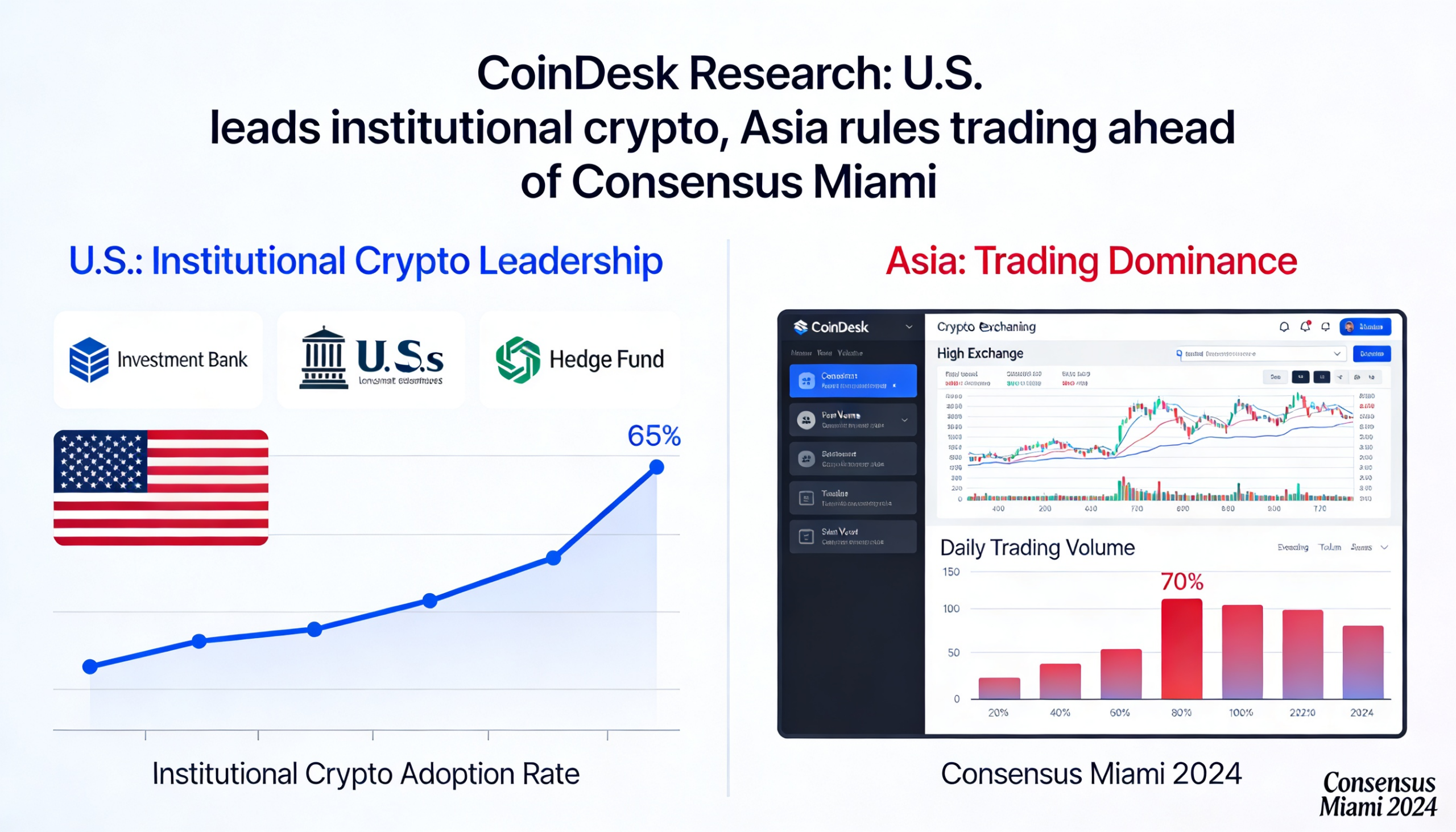
The crypto industry is no longer evolving along a single global path. Instead, it is breaking into distinct layers, with Asia dominating everyday usage, the United States reinforcing its role as the institutional and regulatory center, and Latin America showing how utility-led adoption can take hold in real economies.
According to a new Global Digital Asset Adoption Index from CoinDesk Research released ahead of Consensus Miami, Asia leads across nearly every major activity metric. The region ranks first in exchange trading volumes, stablecoin transaction flows, and crypto ownership rates, underscoring how much of the sector’s core activity now sits outside North America.
The U.S., however, continues to control the institutional backbone of the market. CoinDesk Research finds that America leads in exchange-traded crypto products, custody infrastructure, and regulatory clarity, making it the primary jurisdiction for compliant capital formation and large-scale institutional participation.
Rather than signaling a decline in U.S. influence, the report frames this split as a structural shift in market design. Liquidity, compliance, and user behavior are increasingly decoupled, no longer concentrated within a single region. Asia’s edge comes from strong retail participation and embedded financial integration, while North America’s advantage lies in product depth, licensing regimes, and access to traditional capital markets.
Stablecoins sit at the center of this divergence. In developed markets, they are still largely used for trading and collateral purposes. In emerging economies, by contrast, they are increasingly deployed for remittances, cross-border payments, and inflation protection. The index shows this utility-driven usage continues to drive transaction growth even during periods of weaker price performance.
Latin America highlights a third model. Across several countries, dollar-pegged stablecoins function less as speculative assets and more as everyday financial tools, supporting remittances, commerce, and value preservation amid currency volatility. This has helped sustain transaction activity even during broader market drawdowns.
The findings point to a multipolar digital asset market, where leadership depends less on geography and more on which layer of the crypto stack is in focus—from retail usage and payments to regulation, custody, and institutional capital.