cpeditor
Here’s a rewritten version with clearer structure and refreshed wording while keeping the original meaning intact:
Core inflation rose less than expected in May, but markets still moved lower during afternoon trading as sentiment weakened.
AI investment wave adds another $40B in capital plans
Alongside its earnings report, Oracle (ORCL) announced plans to raise about $40 billion through debt and equity issuance in fiscal 2027 to fund AI-related capital spending. This is in addition to a previously disclosed $20 million at-the-market share offering.
Shares of Oracle fell 1.6% in after-hours trading.
The announcement follows Google’s $85 billion fundraising plans, reports that Meta may be considering a similarly large capital raise, and comes just hours before the anticipated $80 billion SpaceX IPO.
The ongoing shift of capital away from crypto assets appears likely to continue.
Strategy CEO: bitcoin sale not tied to dividends
Speaking to CNBC, Strategy (MSTR) CEO Phong Le said the company’s recent bitcoin sale was intended to calm markets, test internal selling processes (as the firm is far more experienced in buying than selling), and realize tax losses—something the company expects to do more often over time.
He stressed that dividend payments were not a factor, noting that Strategy has other ways to raise cash for distributions.
Le also acknowledged that capital is currently flowing into the SpaceX IPO and AI-related trades but expects it to eventually rotate back into crypto.
Cramer calls bitcoin and gold “bad money” amid rotation
Jim Cramer described bitcoin and gold as “bad money being sold for SpaceX,” while referring to Apple and Nvidia as “good money” being liquidated.
Bitcoin traded near $61,800, essentially flat over the past 24 hours. Gold fell 4.2% to $4,109 per ounce, roughly 20% below its January peak.
Meanwhile, the Nasdaq extended its June decline ahead of the SpaceX IPO, dropping 1.8% on Wednesday and now down about 7% for the month.
Bitcoin miners hit as AI-linked stocks sell off
Bitcoin miners—now increasingly tied to AI data center and infrastructure deals—came under pressure alongside broader tech weakness.
Despite recent strength in the sector, names such as Hut 8 (HUT), CleanSpark (CLSK), TeraWulf (WULF), and Cipher Mining (CIFR) fell 5%–7% as the Nasdaq declined.
Bitcoin itself remained largely unchanged around $61,900.
Oil spikes after Trump comments on Iran
Oil prices surged after President Trump said the U.S. would continue aggressive strikes on Iran.
WTI crude rose 3.3% to $91.11 per barrel following the remarks.
While equities fell, bitcoin briefly moved higher toward $62,400, showing a short-lived decoupling from broader risk-off sentiment before stabilizing near $63,000.
Bitcoin slips below $62K as markets weaken
After an early rebound, U.S. markets turned lower, with the Nasdaq down about 1%.
Geopolitical tensions and anticipation of the SpaceX IPO added to pressure following stronger-than-expected inflation data.
Bitcoin slipped back to around $61,900 after briefly reclaiming $62,000, still modestly positive on the day.
BlackRock outlines fee for Bitcoin income ETF
BlackRock disclosed a 0.65% management fee for its proposed Bitcoin Premium Income ETF (BITA), suggesting the product may soon launch.
The fee is higher than its spot bitcoin ETF but below competing covered-call strategies.
The fund aims to generate income by selling bitcoin-linked options, though this may limit upside participation during strong rallies.
Bitcoin rises above $62K after softer inflation data
Bitcoin climbed above $62,300 after cooler-than-expected inflation data improved risk appetite.
Equities also rebounded, while gold dropped more than 2%.
Crypto-related stocks, including Strategy (MSTR), Robinhood (HOOD), and Coinbase (COIN), gained alongside AI-linked mining firms.
Fold surges after bitcoin sale used to reduce debt
Fold Holdings (FLD) rallied about 100% after revealing it sold bitcoin at roughly $71,000 per coin to raise $45 million.
Part of the proceeds was used to repay bitcoin-backed debt, with the rest allocated to cash reserves and growth initiatives.
The company still retains a significant bitcoin position on its balance sheet.
CPI comes in softer than expected
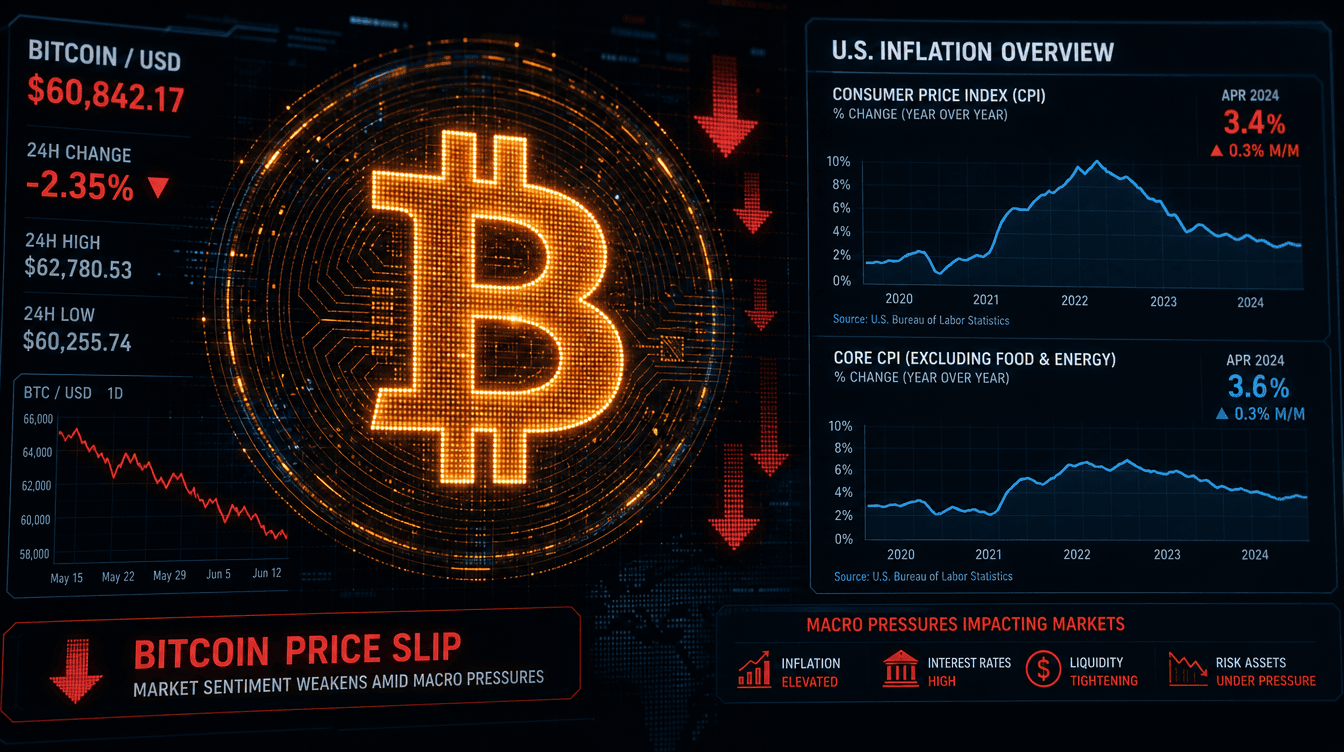
U.S. CPI rose 0.5% month-over-month and 4.2% year-over-year, matching expectations.
Core CPI increased just 0.2% monthly versus forecasts of 0.3%, with annual core inflation at 2.9%.
Bitcoin ticked higher on the softer data, trading near $61,500, while Nasdaq futures trimmed earlier losses.
Markets slide ahead of inflation print
Markets weakened ahead of the CPI release as investors braced for persistent inflation pressures.
Nasdaq futures fell 1.5%, and S&P 500 futures dropped about 1%.
Bitcoin slipped nearly 3% to around $61,000, while Treasury yields remained elevated, reinforcing expectations of tighter monetary policy.
Bitcoin profitability drops toward bear-market levels
On-chain data shows bitcoin profitability is falling toward levels typically seen in late-stage bear markets.
Roughly 45% of bitcoin supply remains in profit, meaning most holders are now underwater.
Historically, such conditions have preceded market bottoms as weaker hands exit and long-term investors accumulate.
Hut 8 secures $4.25B for AI expansion
Hut 8 raised $4.25 billion through debt financing to build a large AI-focused data center in Texas.
The project will deliver a 352-megawatt facility leased to a high-credit-rated tenant.
The deal marks one of the company’s largest funding rounds as it expands further into AI infrastructure.
Markets fall ahead of CPI data
Markets moved lower ahead of inflation figures, with both crypto and equities under pressure.
Bitcoin and Nasdaq futures each fell more than 1% as investors positioned for potentially sticky inflation.
Gold declined while Treasury yields rose, reflecting expectations that interest rates may stay higher for longer.
Bitcoin mining difficulty set for sharp decline
Bitcoin mining difficulty is expected to see its largest drop since February.
The adjustment follows a decline in hash rate, driven by higher energy costs and a shift by miners toward AI and high-performance computing.
Some mining firms are also selling bitcoin and reallocating capital into infrastructure-focused businesses.
Oil volatility eases, Bitcoin remains volatile
Oil market volatility has returned to pre-conflict levels as geopolitical tensions ease.
In contrast, bitcoin volatility has risen, driven by ETF outflows, macro uncertainty, and shifting investor positioning.
SpaceX IPO narrative weighs on crypto liquidity
Ahead of the SpaceX IPO, leveraged crypto contracts tied to the offering have declined sharply.
The move reflects broader risk-off sentiment and capital rotation into large-scale equity offerings.
Bitcoin technical picture weakens further
Some ETF analysts say bitcoin’s technical structure has deteriorated, with price trading well below key moving averages.
While short-term bounces remain possible, broader sentiment stays cautious unless BTC regains higher technical levels.
AI narrative strengthens, crypto trades macro
New AI model releases from major firms have reinforced the dominance of the AI investment theme.
Crypto markets are increasingly trading in line with macro liquidity and risk sentiment, with large-cap assets reacting more to capital flows than sector-specific developments.
If you want, I can also compress this into a single news article, newsletter, or tweet thread format.