cpeditor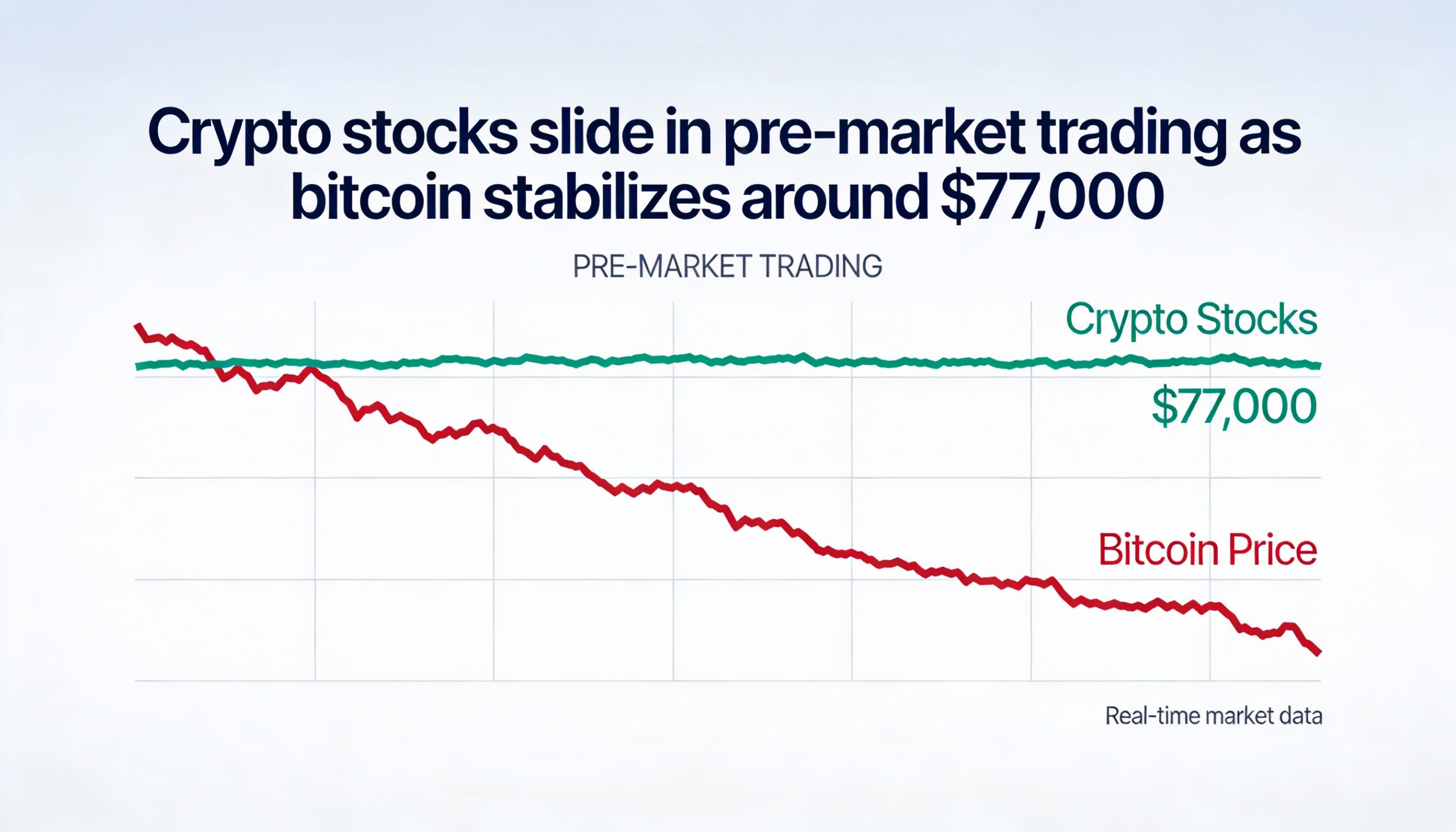
Crypto-linked U.S. stocks declined in pre-market trading as investors continued to assess President Donald Trump’s Friday nomination of Kevin Warsh as Federal Reserve chair, a development that contributed to a sharp selloff in digital assets over the weekend.
Strategy (MSTR), the largest publicly traded corporate holder of bitcoin, fell more than 6%, while Galaxy Digital (GLXY) slid over 7%. Bitcoin mining and AI-exposed companies also weakened, with IREN (IREN) and Cipher Mining (CIFR) down roughly 4% each. Crypto exchange Coinbase (COIN) was also lower by about 4%.
Market volatility continued to intensify. The Cboe Volatility Index (VIX) climbed around 10% on the day, while the Volmex implied volatility index jumped from 40 to 50 over the past week. Rising implied volatility suggests traders are pricing in larger price swings and elevated uncertainty.
Bitcoin was up about 1% on the day, trading near $77,000 after briefly dipping to around $74,500 on Saturday. Pressure extended across other asset classes. Gold slid 4% to roughly $4,700 an ounce, silver fell 4% to $82 an ounce, and oil prices also moved lower. West Texas Intermediate crude futures dropped 5% to $62 a barrel.
U.S. equity index futures showed modest improvement, with the Invesco QQQ Trust (QQQ), which tracks the Nasdaq 100 Index, down less than 1% in pre-market trading.
The U.S. dollar edged lower, with the DXY index easing back to 97. CoinDesk Research has pointed to an inverse relationship between bitcoin and the dollar, a dynamic that appeared to re-emerge as bitcoin ticked higher alongside a softer greenback.