cpeditor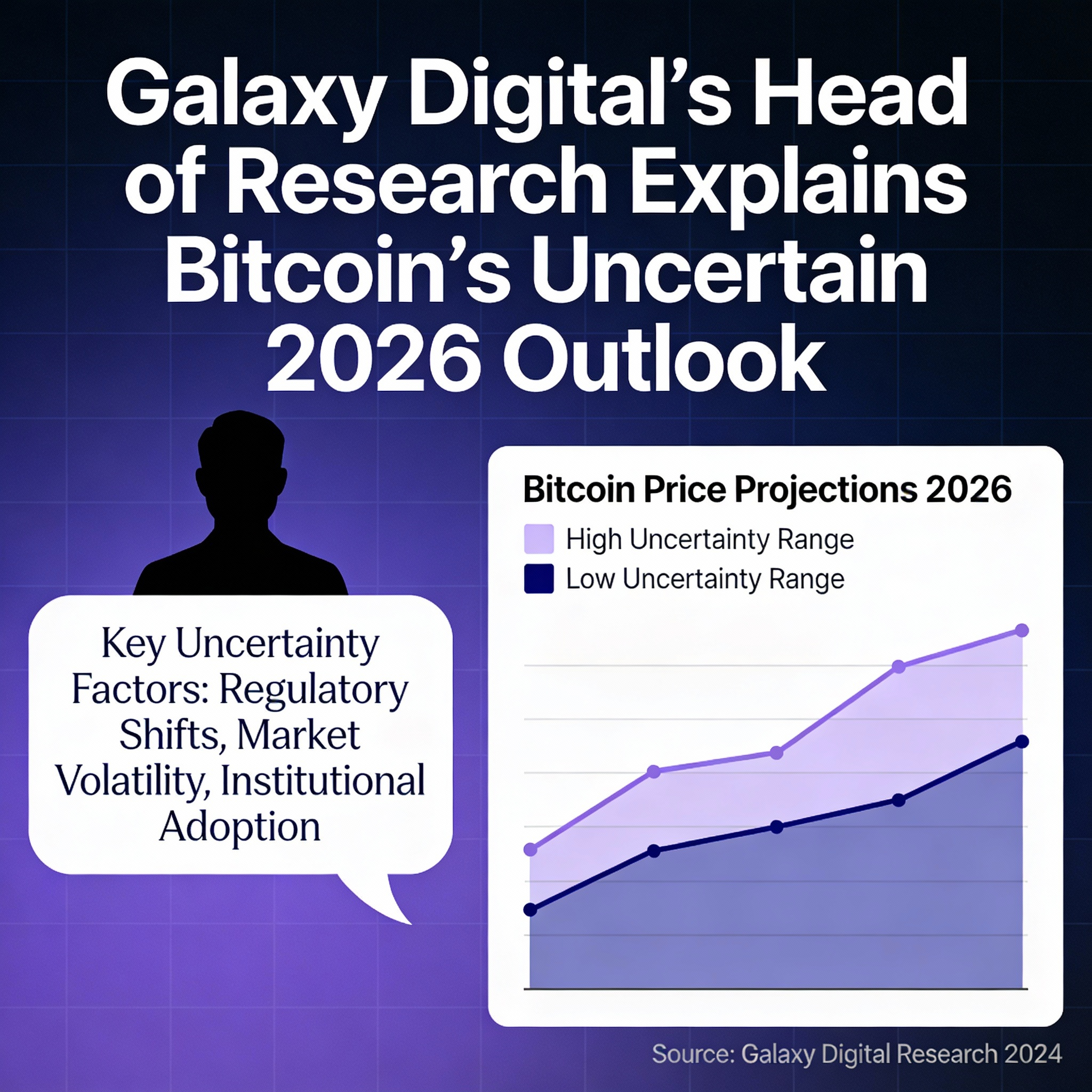
Galaxy Digital’s Alex Thorn says macro uncertainty, options markets, and falling volatility make Bitcoin’s 2026 outlook particularly hard to predict—even as the firm remains bullish over the long term.
Thorn, Galaxy Digital’s head of firmwide research, described the coming year as “too chaotic to predict” in a Dec. 21 post on X. Citing a mix of political risk, macro uncertainty, and uneven crypto market momentum, he stressed that short-term forecasting will be challenging. His comments were based on Galaxy Research’s Dec. 18 report, “26 Crypto, Bitcoin, DeFi, and AI Predictions for 2026,” which outlines the firm’s expectations for crypto markets and institutional adoption.
At present, Thorn noted, the broader crypto market is still deep in a bear phase, with Bitcoin struggling to regain sustained bullish momentum. Until Bitcoin decisively trades above the $100,000–$105,000 range, downside risks remain elevated.
Options markets signal wide uncertainty
Derivatives markets reflect that uncertainty. According to Thorn, Bitcoin options pricing implies roughly equal probabilities for dramatically different outcomes next year. Traders are assigning similar odds to Bitcoin reaching $70,000 or $130,000 by mid-2026, and $50,000 or $250,000 by year-end.
Options markets, widely used by institutional investors to hedge risk, suggest professionals are preparing for large price swings rather than a clear directional trend.
Signs of market maturation
Despite short-term volatility, Thorn sees structural signs of a maturing market. Long-term Bitcoin volatility—measuring price fluctuations over extended periods—has been declining. He attributes part of this trend to institutional strategies such as options overwriting and yield-generation programs, which help dampen extreme price moves.
Bitcoin’s volatility smile, which shows how option prices vary across strike levels, also reflects this maturation. Downside protection is now priced higher than upside exposure, a pattern more typical of mature macro assets like equities and commodities than high-growth markets.
Why a quiet 2026 could still be positive
For Thorn, these structural trends suggest that even a potentially range-bound or “boring” 2026 would not undermine Bitcoin’s long-term case. Even if prices drift lower or approach long-term technical levels like the 200-week moving average, institutional adoption and market maturation are expected to continue.
Galaxy’s report highlights that integration into mainstream investment platforms could embed Bitcoin into standard portfolios, generating persistent flows regardless of short-term price cycles. Thorn sees expanding institutional access, potential easing of monetary conditions, and demand for alternatives to fiat currencies as key drivers.
Looking further ahead, Galaxy predicts that Bitcoin could follow gold’s path as a hedge against monetary debasement, potentially reaching $250,000 by the end of 2027.