cpeditor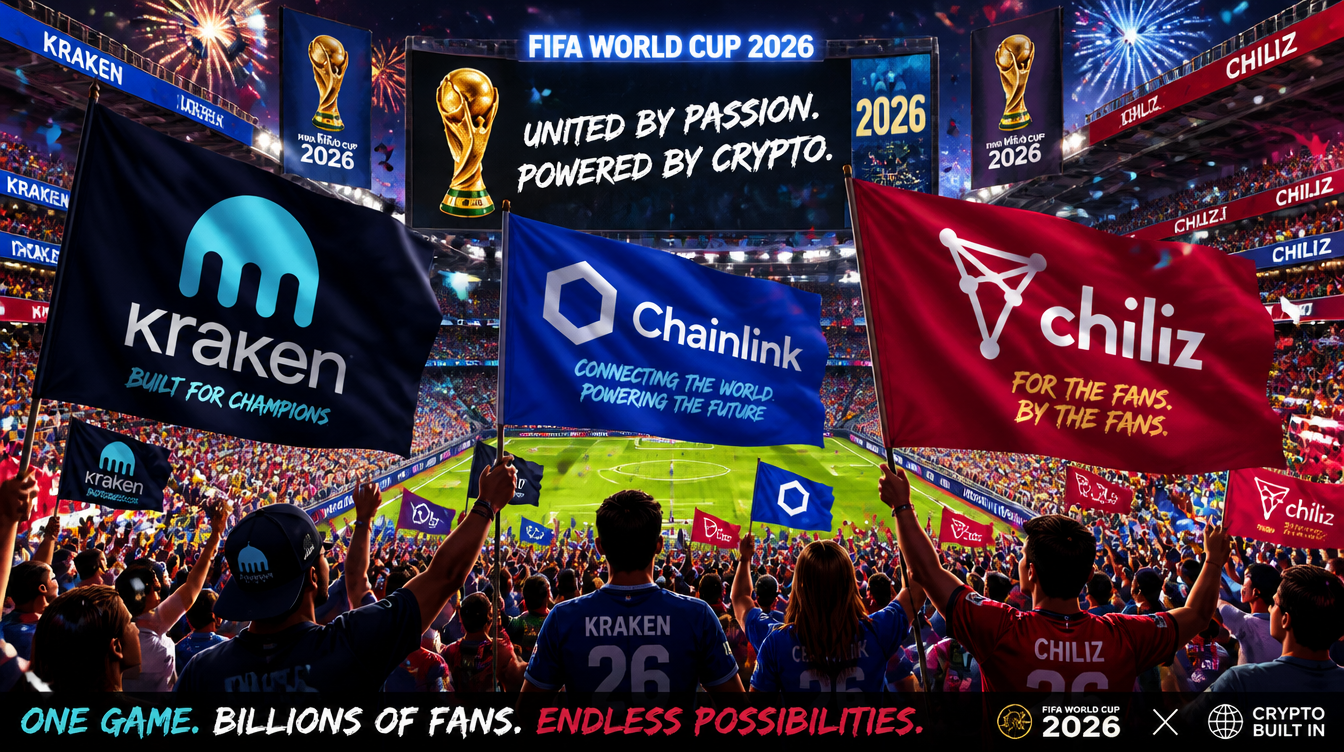
The FIFA World Cup 2026 is not just the largest tournament in football history—it’s also becoming a major showcase for cryptocurrency adoption.
With 48 teams competing across 104 matches in 16 cities throughout the United States, Canada, and Mexico, this year’s tournament features an unprecedented level of blockchain integration. From crypto exchanges and prediction markets to fan tokens and on-chain ticketing, digital asset companies are playing a bigger role than ever before on football’s biggest stage.
Leading that push are Kraken, Chainlink, and Chiliz, each representing a different corner of the crypto ecosystem. Together, they highlight how far the industry has progressed since the last World Cup.
Kraken Gains Access to a Global Audience
Kraken enters the tournament as FIFA World Cup 2026’s Official Crypto Exchange Supporter, giving the exchange one of the most visible sponsorship positions ever secured by a crypto company.
The partnership spans fan engagement campaigns and digital experiences across North America and Europe during the tournament’s seven-week schedule. With FIFA expecting billions of viewers worldwide, the deal provides Kraken with exposure that few crypto brands have ever enjoyed.
For the exchange, the sponsorship is less about branding and more about reaching a mainstream audience at a truly global scale. Operating in more than 190 countries, Kraken sees the World Cup as an opportunity to introduce digital assets to millions of potential users who may have little prior exposure to the industry.
Kraken Co-CEO Arjun Sethi described football as one of the few events capable of bringing together people across virtually every country and culture at the same moment. The company believes financial systems should be equally connected and accessible.
The sponsorship also expands Kraken’s growing sports portfolio, which already includes partnerships with major football clubs and motorsport organizations. However, the World Cup’s global reach exceeds anything in its existing lineup.
That said, Kraken remains a FIFA Supporter rather than a Global Partner. The highest sponsorship tier is still occupied by multinational brands such as Visa, Adidas, Coca-Cola, and Hyundai-Kia, highlighting that crypto has gained visibility within FIFA’s ecosystem but has yet to achieve top-tier commercial status.
Chainlink Brings Decentralized Infrastructure to FIFA
Another first for the tournament comes through ADI PredictStreet, which has launched FIFA’s inaugural official prediction market powered by Chainlink’s oracle technology.
The platform uses Chainlink to deliver verified match outcomes directly on-chain. Once results are confirmed through trusted data sources, smart contracts automatically settle prediction markets without requiring intervention from a centralized operator.
This model represents a significant departure from traditional prediction platforms, where settlement decisions are typically handled by the platform itself.
ADI PredictStreet selected Chainlink because of its ability to provide secure, transparent, and verifiable data feeds, according to CEO Dimitrios Psarrakis. Chainlink Labs executive Johann Eid said the collaboration demonstrates how prediction markets can evolve into a deeper layer of fan engagement rather than remaining a niche betting product.
For blockchain advocates, the partnership offers a real-world example of decentralized infrastructure supporting a global sporting event.
A Defining Moment for Crypto in Sports
The broader significance of FIFA World Cup 2026 extends beyond any single partnership.
For the first time, multiple crypto sectors are participating simultaneously in one of the world’s largest sporting events. Kraken represents exchanges, Chainlink provides oracle infrastructure, ADI PredictStreet powers prediction markets, Chiliz drives fan token engagement, and Avalanche supports blockchain-based ticketing solutions.
The combined presence creates a level of crypto exposure that previous World Cups never achieved.
By comparison, FIFA World Cup Qatar 2022 relied largely on a single blockchain relationship through Algorand, which supported NFT and wallet initiatives before the broader crypto downturn reduced momentum across the sector.
The 2026 tournament reflects a more mature approach. Rather than relying on one blockchain company, FIFA now works with multiple independent platforms serving different functions across its ecosystem.
Still, a key milestone remains out of reach. While crypto companies have established a meaningful presence across several categories, none have yet secured FIFA’s prestigious Global Partner designation.
Whether that changes by the 2030 World Cup may depend on the results of this tournament. Over the next seven weeks, crypto companies have an opportunity to demonstrate that blockchain technology can enhance fan experiences at scale. If the engagement metrics are strong enough, the next World Cup could see the industry move even closer to football’s commercial top tier.