cpeditor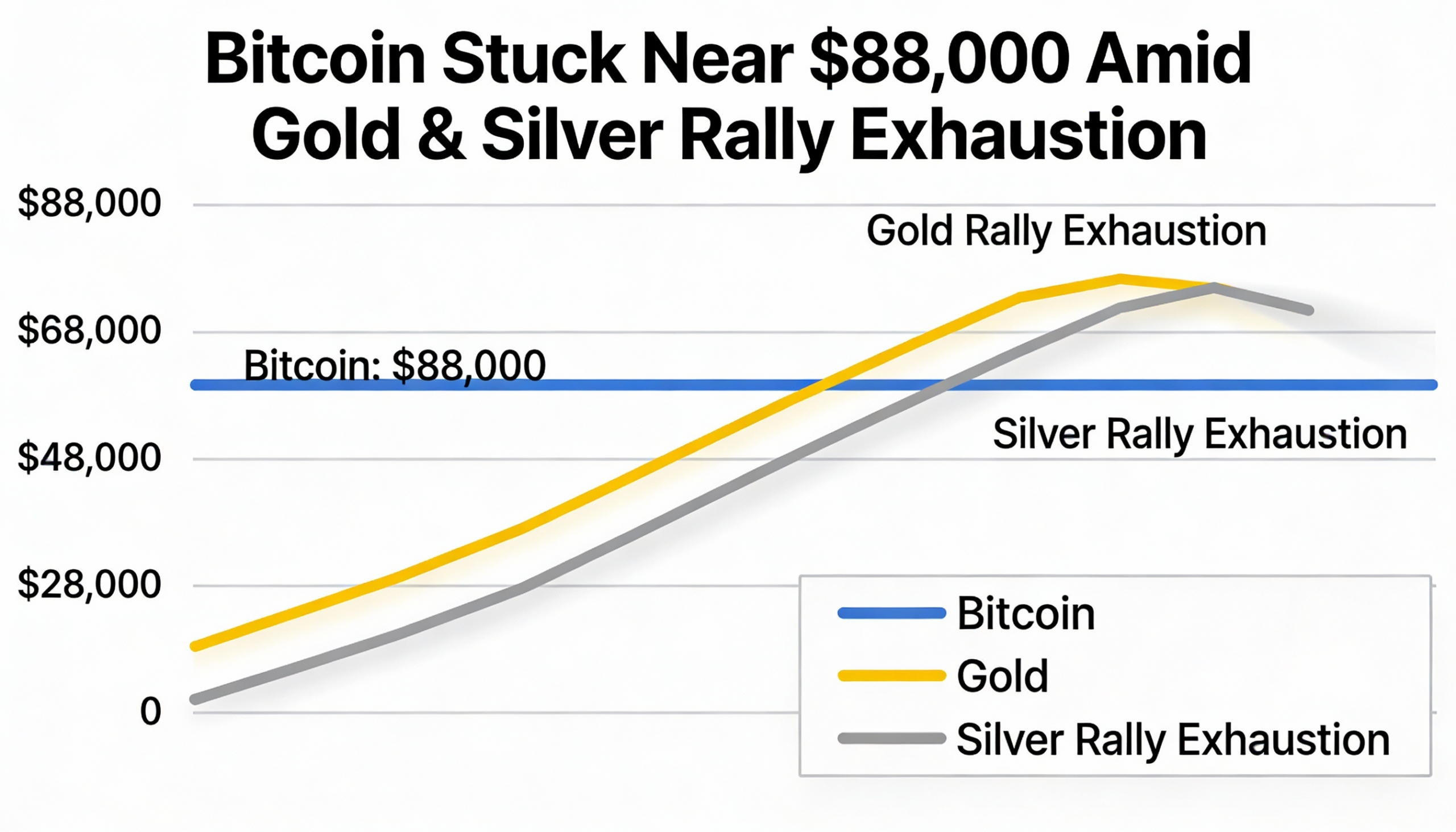
Bitcoin remained stuck near $88,000 on Monday, showing little reaction even as gold and silver hit record highs before easing slightly.
The cryptocurrency recovered modestly from weekend selling but remained below Friday’s peak near $90,000. Rising concerns over a potential U.S. government shutdown on Jan. 31, and the possible liquidity impact, were cited as a major factor behind Sunday’s dip.
Precious metals, however, shrugged off the uncertainty. Gold surged past $5,000 and briefly topped $5,100 for the first time, while silver climbed to $118. By Monday afternoon, gold had pulled back to $5,043, still up 1.3% on the day, and silver retreated to $108, maintaining roughly a 7% gain. “Gold and silver casually adding an entire bitcoin market cap in a single day,” noted crypto analyst Will Clemente, highlighting the contrast with bitcoin’s muted response.
The U.S. dollar index (DXY) fell to its weakest level since September, following reports that the Federal Reserve and the Bank of Japan coordinated interventions to support the yen. The dollar slipped more than 1% to 154.07 per yen.
Bitcoin outlook cautious
Despite a weaker dollar, bitcoin has shown limited bullish follow-through, leaving traders wary. Analysts at Swissblock warned that a break below $84,500 could trigger a deeper decline toward $74,000. Conversely, if support holds and risk metrics ease, it could create a favorable entry point for buyers.
Bitfinex analysts expect BTC to remain range-bound between $85,000 and $94,500. They pointed to options market activity indicating that traders are hedging short-term risks without anticipating longer-term volatility spikes. The market, they said, is “pricing transitory risk rather than a sustained disruption to market structure.”
ETF outflows and regulatory overhang
Selling pressure has been compounded by continued outflows from spot bitcoin ETFs, which totaled over $1.3 billion in the past week, signaling cautious investor sentiment.
Jim Ferraioli, Schwab’s director of crypto research and strategy, said BTC is unlikely to make a sustained move without improvements in on-chain activity, ETF flows, derivatives positioning, or miner participation. He noted that progress on the Clarity Act could be a meaningful catalyst, but that effort may be delayed by a potential government shutdown. Until then, he expects bitcoin to trade in a relatively narrow range between the low $80,000s and mid-$90,000s, with major institutional players remaining on the sidelines.