cpeditor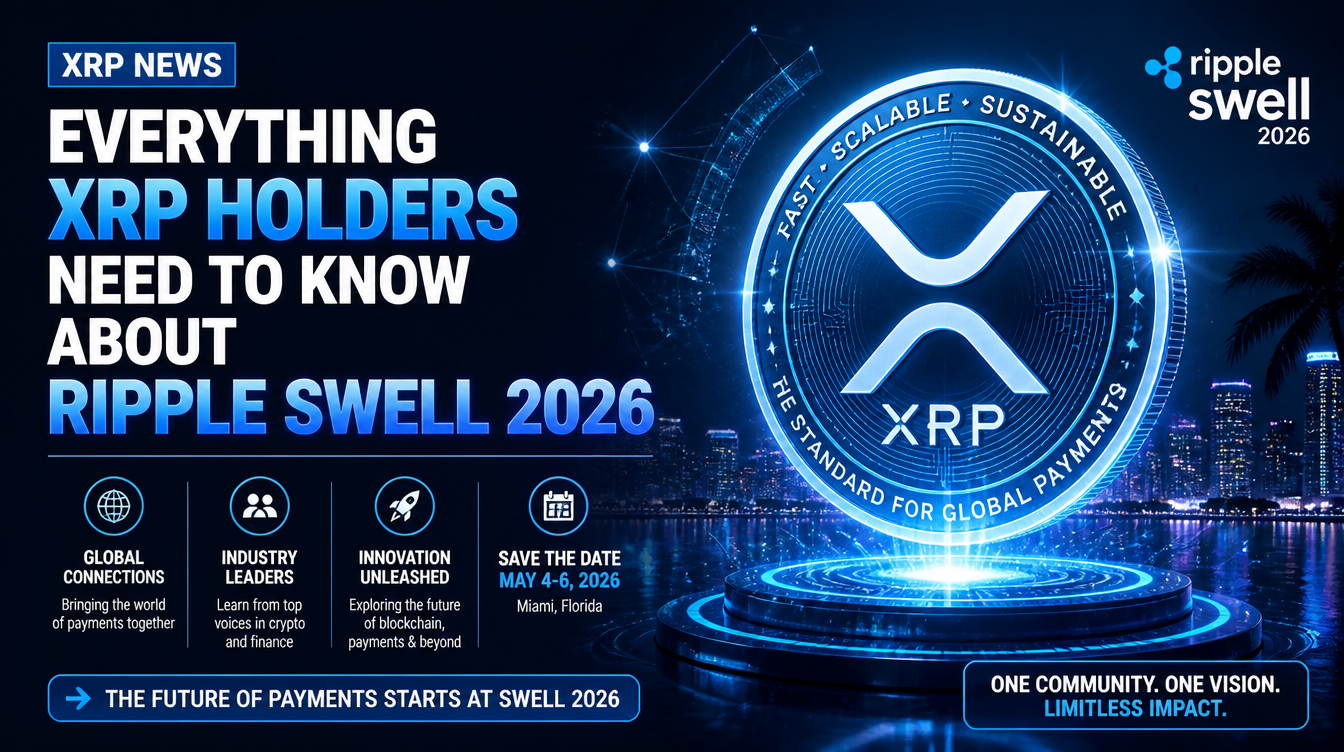
XRP News: Ripple Swell 2026 Preview and What It Means for XRP
Ripple Swell 2026 is scheduled for October 27–29 at The Shed in Hudson Yards, New York City. For the first time, Ripple is merging its XRPL Apex developer conference into Swell, unifying institutional and developer audiences into a single flagship three-day event.
This makes it the largest Swell to date, expected to bring together more than 1,500 attendees, over 75 speakers, and 50+ sessions across three parallel tracks focused on institutions, developers, and emerging technologies.
The consolidation is strategically significant. Swell has traditionally been oriented toward banks, payment providers, and institutional finance, while Apex served XRP Ledger developers. Combining the two reflects Ripple’s goal of aligning enterprise adoption with on-chain development, positioning the XRP Ledger as a unified financial infrastructure stack rather than two separate communities.
Ripple CTO Emeritus David Schwartz reinforced this direction in a June 17 post on X, emphasizing real-world utility over hype. His focus on payments, tokenization, DeFi, interoperability, and AI—alongside a direct invitation to builders—signals the narrative Ripple is pushing into the final quarter.
What the Swell–Apex Merger Changes
Ripple previously operated Swell and XRPL Apex as separate events: Swell for institutional audiences and Apex for developers building on the XRP Ledger.
Their merger in 2026 represents the most meaningful structural change since Swell began in 2017.
The new format introduces three simultaneous tracks: Institution (banking and fintech integration), Ecosystem (XRPL tools and infrastructure), and Innovation (AI, quantum-resistant security, and emerging applications). The agenda spans tokenized real-world assets, regulatory frameworks, custody, stablecoins, capital markets, settlement systems, crypto ETFs, DeFi, financial inclusion, and treasury management.
The scope signals a clear expansion from a payments narrative toward a broader discussion covering both traditional finance and blockchain infrastructure deployment.
Ripple has also asked speakers to focus on measurable outcomes such as reduced settlement times, lower FX costs, and real-world tokenization revenue generation. This shifts attention toward implementation-driven results rather than conceptual ideas.
Additional speakers and session details are expected to be released throughout mid-2026 as partnerships are finalized.
Key Speakers and Why They Matter
Ripple CEO Brad Garlinghouse and President Monica Long will lead the institutional track. Garlinghouse is expected to highlight XRP’s core strengths—fast settlement, low fees, and large transaction volume—likely updated with new enterprise integrations.
David Schwartz’s continued role as CTO Emeritus preserves technical depth and strengthens the developer-facing narrative.
External speakers broaden the discussion beyond crypto-native topics. Tom Farley, CEO of Bullish, contributes a regulated exchange perspective at a time when institutional digital asset infrastructure faces increasing oversight. Billy Hult, CEO of Tradeweb, connects XRPL discussions to global capital markets, where tokenized settlement could intersect with trillions in bond and derivatives flows.
Matt Damon, co-founder of Water.org, brings a humanitarian angle, reinforcing Ripple’s emphasis on financial inclusion and cross-border payments.
Swell 2025 already reflected rising institutional interest in stablecoins and tokenized assets. Swell 2026 builds on that momentum by fully integrating developers and institutions into one shared platform.
Market Outlook: What to Watch for XRP
Swell has historically acted as a volatility catalyst for XRP, with trading activity often clustering around the event period.
Heading into 2026, Ripple benefits from a relatively strong institutional backdrop, including progress on a crypto trust bank charter, expansion of RLUSD across multiple networks, and Mastercard’s AI payments initiative involving Ripple.
This increases the probability of multiple meaningful announcements during the three-day event rather than a single headline reveal.
However, elevated expectations also introduce risk. If markets price in strong outcomes ahead of time, Swell could become a classic “sell-the-news” event even if developments are positive.
The key factor will be whether Ripple delivers concrete institutional commitments—such as named banking integrations, measurable tokenization pilots, or regulated partnerships—rather than broad strategic statements.
Schwartz’s emphasis on builders and execution suggests Ripple is framing Swell 2026 as a delivery-focused milestone. That positioning will likely shape whether XRP sustains momentum or experiences short-term volatility after the event.