cpeditor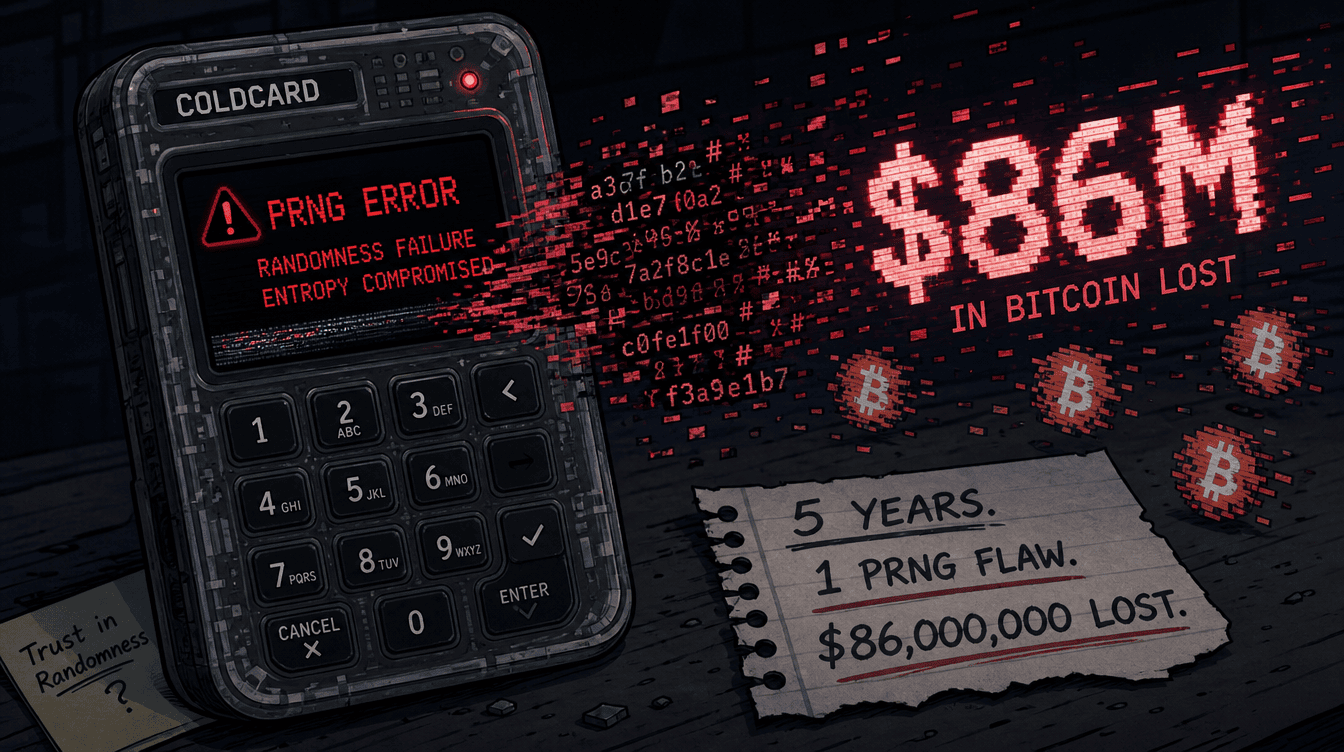
A hidden configuration mistake in Coldcard’s firmware weakened wallet seed security for nearly five years, ultimately leading to the theft of 1,367 BTC from 4,585 addresses.
Galaxy Research’s on-chain analysis published on Aug. 2, 2026, revealed that a pseudo-random number generator (PRNG) flaw present in Coldcard hardware wallet firmware since March 2021 resulted in confirmed losses of 1,367 BTC, worth approximately $86 million.
The attack marks the largest confirmed hardware wallet exploit in Bitcoin history based on stolen funds. Unlike many crypto hacks, it did not involve phishing, device theft, or user error. Instead, the vulnerability existed within the wallet creation process itself.
The incident underscores a major reality of self-custody: the security of a wallet depends heavily on the quality of the randomness used to generate recovery seeds. A single coding mistake can weaken that foundation for years while remaining invisible to users and developers.
The exploit occurred as Bitcoin traded around $62,250, down 1.4% on the day after a volatile week that saw BTC retreat from above $65,000. Daily trading volume was approximately $16.9 billion, compared with more than $20 billion the previous day.
The Technical Issue Behind the Coldcard Breach
Block’s engineering team identified the root cause in Coldcard’s libngu library. Coinkite had intentionally set a board configuration value to zero to disable MicroPython’s random number generator and ensure that the device relied on its hardware true random number generator (TRNG).
However, the security check within the libngu library only verified whether the macro existed, not whether the value was valid. This allowed the zero configuration to bypass the intended protection.
As a result, MicroPython removed the STM32 hardware RNG function during compilation and switched to Yasmarang, a software-based PRNG that delivered only around 40 bits of effective entropy. This was far below the 128 bits of randomness typically expected for a BIP-39 recovery seed.
Although newer Coldcard models, including the Mk4, Mk5, and Q, improved entropy levels to an estimated 72 bits, they still fell short of the ideal standard. The difference between 40-bit entropy and 128-bit entropy creates a significant increase in the ability of attackers to target vulnerable seeds.
Coinkite issued a security notice on July 30, 2026, shortly before attackers drained around 594 BTC from approximately 500 wallet addresses. Additional attack waves followed, bringing the total confirmed theft to 1,367.05 BTC across 4,585 addresses by Aug. 2.
The majority of the stolen Bitcoin remains unmoved, indicating that the attacker has not yet attempted to transfer or liquidate the funds.
Coldcard Incident Reflects a Broader Security Pattern
The Coldcard exploit follows several major crypto security failures linked to weak randomness during private key generation.
In 2013, an Android SecureRandom flaw caused repeated ECDSA nonces, exposing private keys from multiple Bitcoin wallets. In 2022, the Profanity vanity address generator vulnerability contributed to the Wintermute attack, where attackers exploited weak 32-bit entropy and stole approximately $160 million.
The Milk Sad vulnerability disclosed in 2023 revealed that Libbitcoin Explorer’s bx seed tool relied on a Mersenne Twister generator seeded by system time. The flaw reduced the expected 256-bit entropy to roughly 32 bits and exposed more than 120,000 wallets.
While these incidents involved different software and platforms, they all shared the same fundamental weakness: a random number source that was assumed to be secure but failed to provide sufficient protection.
Ari Redbord, global head of policy at TRM Labs, said the Coldcard breach shows that self-custody does not eliminate risk but instead shifts responsibility toward wallet security and key management. TRM Labs data from the first half of 2026 showed that infrastructure and key-related compromises accounted for 15% of incidents but caused 76% of total losses across 207 reported hacks.
Galaxy Research said it has identified roughly 600 suspected attacker-controlled addresses and provided the information to federal investigators, compliance providers, and cybersecurity companies.
The firm noted that its Coldcard-related findings are based on blockchain activity patterns and on-chain analysis rather than direct computational recovery of seed phrases for every affected address.