cpeditor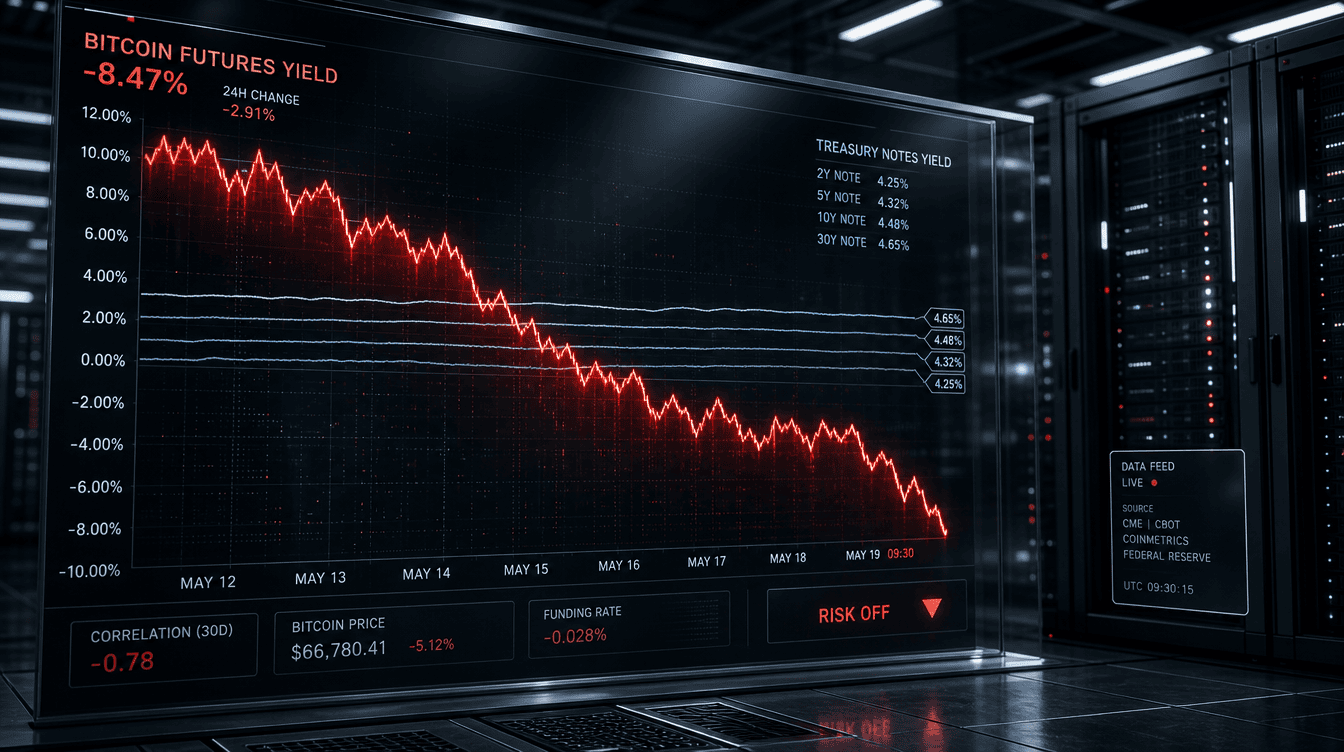
Bitcoin futures’ once-highly profitable carry trade has faded significantly, with quarterly basis yields remaining below two-year U.S. Treasury returns since February. The shift reflects declining arbitrage opportunities and suggests the crypto market is moving toward greater efficiency.
The strategy that previously attracted large amounts of trading capital has lost its edge, with bitcoin futures now consistently generating lower returns than traditional government bonds.
During the 2021 bull market, bitcoin futures carry trades regularly delivered annualized returns of 20% or more on both regulated and offshore exchanges. Traders typically profited by shorting bitcoin futures while holding equivalent spot bitcoin exposure, capturing the difference between futures and spot prices. Today, the same strategy earns only around 3%, compared with roughly 3.8% from two-year Treasury notes.
The futures basis, which represents the price gap between futures contracts and the underlying spot market, has historically been a key source of arbitrage income for traders. However, annualized bitcoin futures basis yields have remained below two-year Treasury rates for over five months, according to Glassnode.
Glassnode reported that three-month bitcoin futures basis yields have trailed Treasury yields since February, making this one of the longest periods of underperformance on record. The only similar period occurred between August 2022 and January 2023, which ended near the market’s cycle bottom.
The current stretch has continued for 157 days, with futures basis returns staying below the yield offered by two-year government bonds.
As futures carry returns fall below risk-free Treasury yields, traders and institutional investors have less incentive to pursue the strategy. Capital that once flowed into bitcoin arbitrage trades can now generate comparable returns through government debt with significantly lower risk.
The decline in carry profitability has coincided with weaker bitcoin futures activity. July trading volume slipped to just above $880 million, extending the drop from February’s record level of $1.47 trillion, according to Coinglass data. The broader crypto market slowdown has also contributed to reduced derivatives demand.
Still, the falling futures basis may represent a positive structural change for the market. Since basis trading depends on inefficiencies between connected markets, smaller spreads indicate improved price alignment. Over time, this could support deeper liquidity, narrower spreads, more effective hedging, and a more stable trading environment for bitcoin.