cpeditor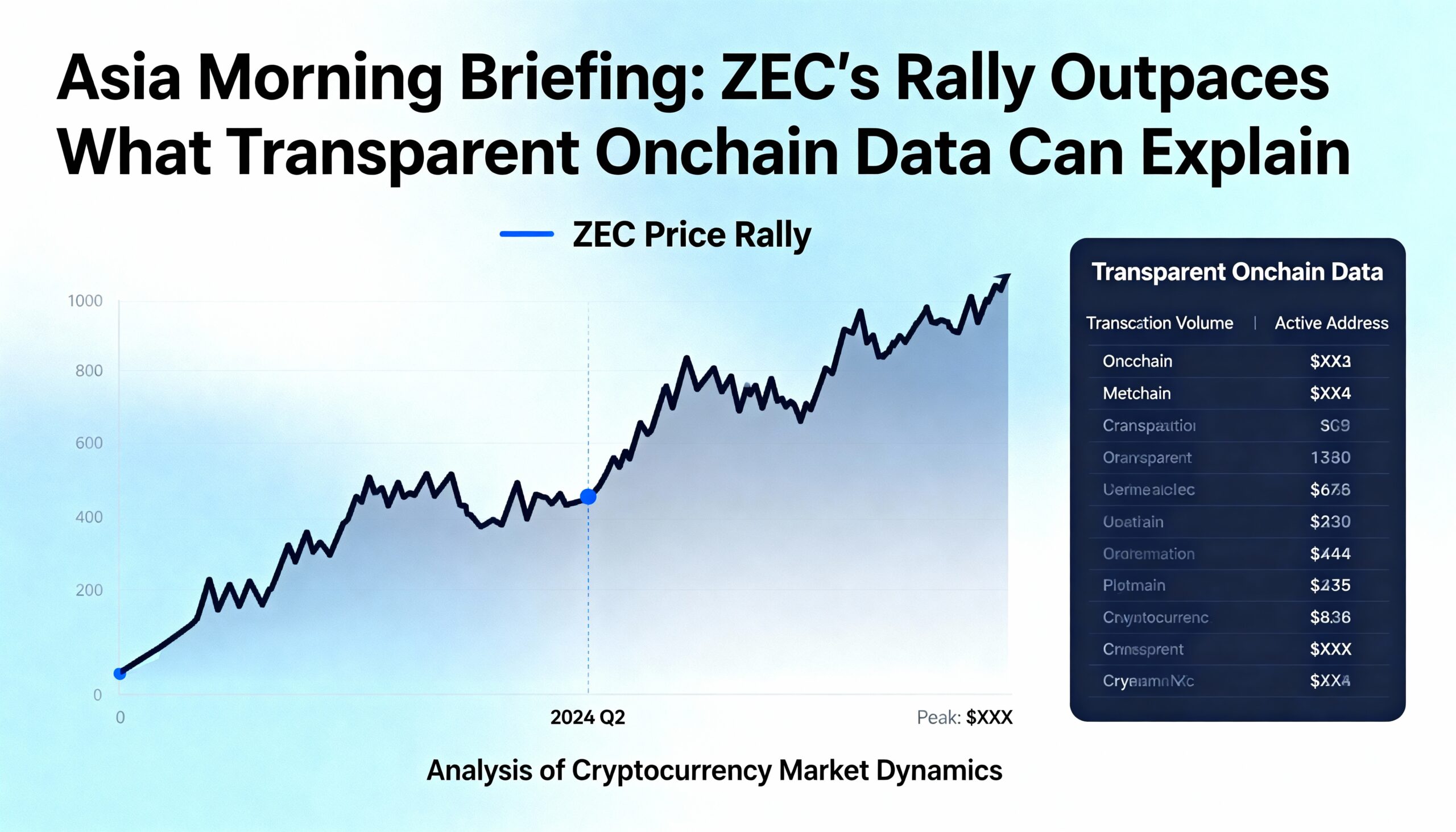
Zcash’s powerful rally this year stands in stark contrast to what its observable network data suggests, raising questions about how much of the move is driven by fundamentals versus market positioning. While Monero’s activity continues to reflect steady, organic demand for privacy-focused assets, Zcash’s surge looks more like a high-beta rotation disconnected from real user growth.
Good Morning, Asia. Here’s what’s moving markets today:
Zcash (ZEC$492.54) has emerged as one of 2025’s top performers, sharply outperforming large-cap assets such as bitcoin and ether even as broader crypto markets pulled back. Yet the scale of ZEC’s price appreciation doesn’t match what can be seen on-chain.
Zcash’s dual-structure privacy model—split between transparent and shielded transactions—limits visibility into its actual user base. Only transparent activity can be measured directly, while the rapidly expanding shielded pool obscures addresses, amounts, and flows from public analytics tools.
The most notable spike in transparent throughput came during the short-lived Zerdinals inscription frenzy, which drove daily transactions above 70,000. But the number of unique transparent senders stayed confined to an 8,000–14,000 range, indicating that the burst was fueled by a small cluster of repeat users rather than broad adoption. Once the inscription wave eased, transaction numbers reverted to previous levels.
Meanwhile, the shielded side of the network continues to grow quietly. Supply within the Orchard pool has increased from roughly 1.2 million to more than 4 million ZEC in recent years, and fully shielded transactions are at all-time highs. Features such as Unified Addresses, auto-shielding, and Zashi’s default-private interface are channeling more activity into the invisible portion of the network—but this growth leaves almost no public footprint.
If the market were witnessing a widespread surge in demand for privacy coins, Monero would typically show similar patterns. Instead, Monero’s network remains stable, with daily transactions holding between 20,000 and 30,000—its normal long-term range. That steadiness suggests the ZEC rally is not part of a sector-wide privacy boom but rather a Zcash-specific rotation fueled by liquidity dynamics, reduced transparent supply, and strong sentiment around its improving private UX.
Despite the privacy differences between the two networks, neither Zcash nor Monero shows a measurable increase in total users. Transparent ZEC metrics show no influx of new participants, and shielded flows are intentionally opaque. With roughly 30% of ZEC supply now held in shielded addresses—unusable on exchanges—the resulting supply contraction has magnified price moves beyond what visible activity can justify.
Until there is clearer evidence of user growth on the private side, traders may be overpaying for ZEC relative to what the accessible data supports.
Market Snapshot
BTC: Bitcoin trades around $86,800 after retreating from an Nvidia-driven push above $93,000.
ETH: Ethereum hovers near $2,850 after slipping under $2,900 amid selling pressure from FG Nexus.
Gold: Gold sits around $4,077, giving back pre-NFP gains but still on track for a yearly rise of more than 50%, roughly 7% below its October peak.
Nikkei 225: Japan’s benchmark index fell 1.58% as hotter October inflation strengthened expectations for BOJ rate hikes and renewed concerns over yen weakness.
Also in Crypto
- Crypto lobbyists seek to influence Trump as congressional gridlock persists (CoinDesk)
- Ray Dalio still holds bitcoin but flags concerns over traceability and quantum risk (Decrypt)
- MegaETH to open pre-deposits for its USDm stablecoin next week (The Block)