cpeditor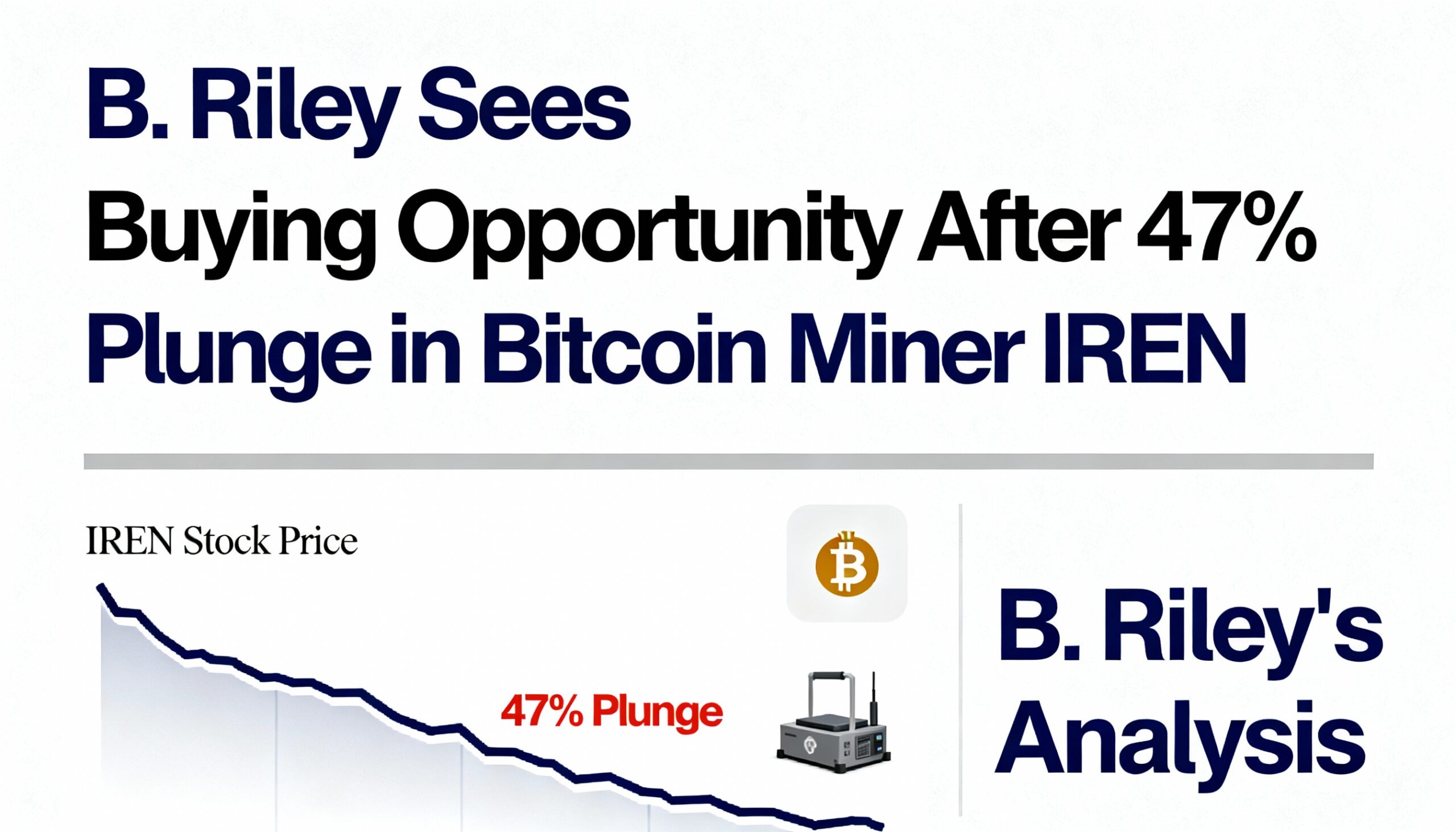
B. Riley reiterated its buy rating on IREN with a $74 price target, pointing to a ramp-up in Microsoft-linked GPU deployments and what it sees as sufficient funding flexibility despite the stock’s sharp pullback.
Shares of the bitcoin miner and high-performance computing (HPC) operator have fallen 47% from their Nov. 5 52-week high, materially underperforming both mining peers and GPU cloud names. In a Monday report, analysts Nick Giles and Fedor Shabalin said the decline reflects a reset in investor sentiment toward volatile AI proxies rather than any deterioration in fundamentals.
Over the same period, publicly traded miners are down about 25% on average, while CoreWeave has slid 31% and Nebius has dropped roughly 25%. IREN was down a further 8.2% in early trading on Monday, at $36.82.
The analysts highlighted IREN’s recent share-price volatility, noting that the stock has a tendency to overshoot in both directions. Between Oct. 22 and Nov. 5, IREN rallied 47%, compared with roughly 13% gains for its HPC peer group, while CoreWeave declined 6% and Nebius rose 19%. According to B. Riley, this pattern suggests AI-driven selloffs can create attractive entry points for investors willing to tolerate sector swings.
On funding, the bank estimates IREN faces a roughly $2.7 billion gap between available capital and about $11.6 billion of planned HPC capital expenditures. That includes approximately $900 million for 23,000 GPUs at Prince George, $1.85 billion for 40,000 GPUs at Mackenzie and Canal Flats, and $8.8 billion for 76,000 GPUs tied to Microsoft at the Childress campus.
B. Riley estimates about $8.85 billion of capital is already secured, including Microsoft’s 20% prepayment totaling $1.94 billion, an estimated $2.5 billion in financing related to the Microsoft GPU deployment, and roughly $1 billion in cash and equivalents.
The report also pointed to recent balance-sheet actions, including $2.3 billion in new convertible senior notes due in 2032 and 2033, in addition to existing 2029 and 2031 convertibles. Net proceeds of roughly $2.27 billion were used to fund a $201 million capped call with an initial cap price of $82.24 per share, as well as the repurchase of approximately $227.7 million of 2030 notes and $316.6 million of 2029 notes. Separately, a registered direct offering completed on Dec. 8 raised additional equity capital through the sale of 39.7 million shares at $41.12.
Taken together, B. Riley said the recent pullback reflects weak AI sentiment in a highly cyclical segment of the market, rather than a structural change in IREN’s Microsoft-focused GPU buildout. The bank said the decline offers investors an opportunity to build positions ahead of a potential recovery in AI enthusiasm and continued execution on the company’s HPC expansion.