cpeditor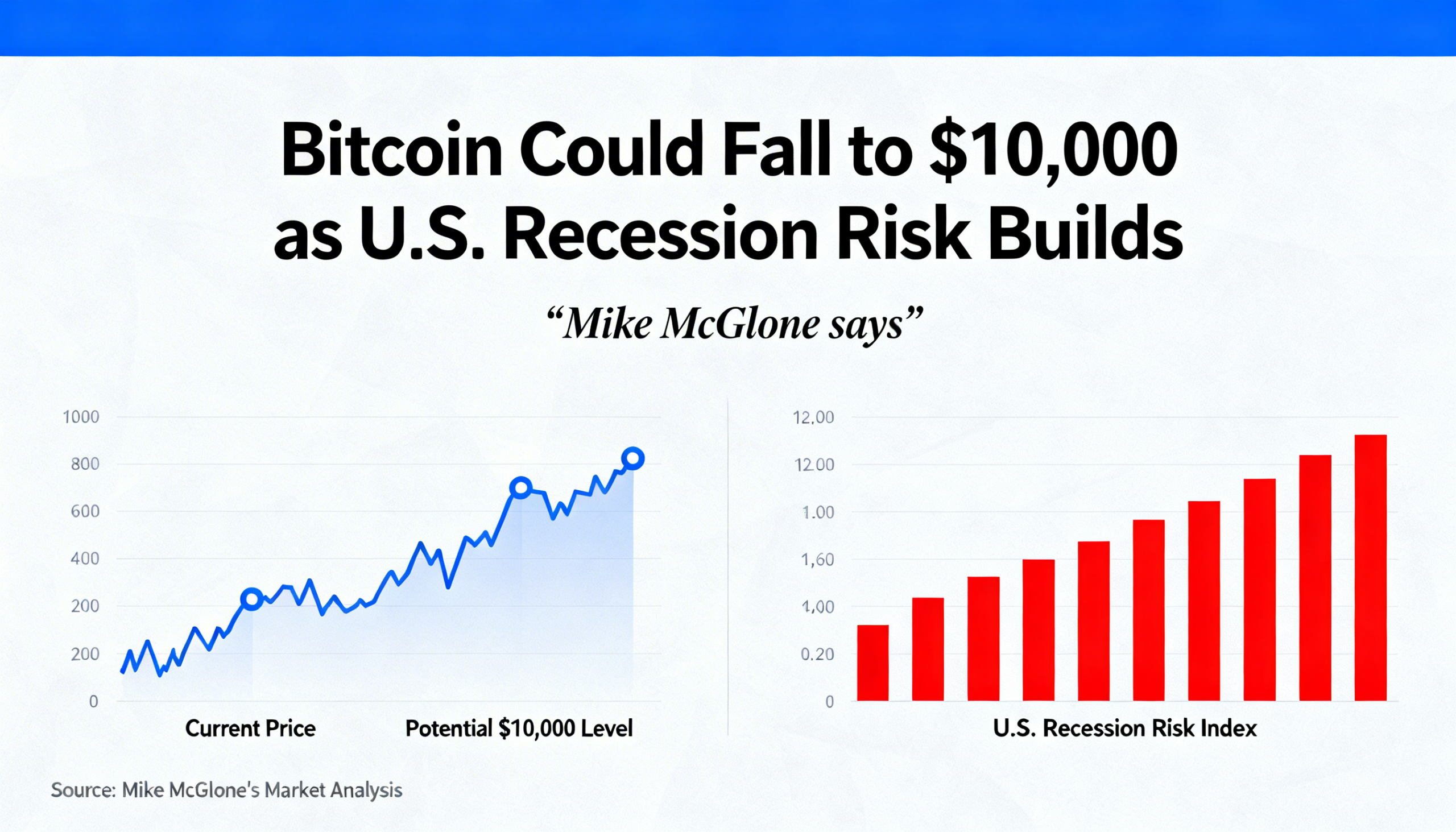
Bloomberg Intelligence macro strategist Mike McGlone warned that the latest slide in cryptocurrencies could be signaling broader financial fragility, arguing that bitcoin may ultimately retreat toward $10,000 and potentially mark the onset of a U.S. recession.
In remarks posted on X, McGlone suggested the “buy the dip” strategy that has supported risk assets since the 2008 financial crisis may be losing traction as digital assets weaken and volatility dynamics shift.
Bitcoin climbed from $65,395 late on Feb. 12 to $70,841 by 07:00 UTC on Feb. 15, before easing back to around $68,800. The wider crypto market remained under pressure, with 85 of the top 100 tokens trading lower. Privacy-focused monero and zcash fell 10% and 8%, respectively, over the past 24 hours.
“Healthy correction is what we should hear soon from stock market analysts (who risk unemployment if not onboard), following collapsing cryptos,” McGlone wrote, adding that the post-2008 dip-buying narrative may be nearing exhaustion.
He highlighted stretched macro indicators to support his case. U.S. equity market capitalization relative to GDP has reached its highest level in roughly a century. At the same time, 180-day volatility in both the S&P 500 and Nasdaq 100 is hovering near eight-year lows — a combination he views as potentially unstable.
McGlone also described the unwinding of a “crypto bubble” and said that “Trump euphoria” has likely peaked, contributing to contagion across asset classes. Meanwhile, gold and silver are “grabbing alpha” at a pace not seen in about 50 years, with rising volatility that he believes could eventually spill over into equities.
Sharing a chart that scaled bitcoin by dividing its price by 10 and plotted it against the S&P 500, McGlone noted that both were trading below 7,000 on his framework as of Feb. 13. Given bitcoin’s high-beta profile, he argued, it is unlikely to remain elevated if broader equity beta deteriorates.
As an initial “normal reversion” level, he pointed to 5,600 on the S&P 500 — roughly equivalent to $56,000 for bitcoin under his scaling method. Beyond that, part of his base-case scenario envisions bitcoin falling toward $10,000 should U.S. equities peak and reverse.
Not everyone agrees
Jason Fernandes, co-founder of AdLunam, disputed McGlone’s bearish outlook in comments to CoinDesk, arguing that it assumes excess must unwind through collapse and that bitcoin’s equity correlation guarantees a similar crash.
“That’s false equivalence and single-path bias,” Fernandes said. “Markets can correct through time, rotation, or inflation erosion. A slowdown could mean consolidation or a reset to $40,000–$50,000, not necessarily a systemic breakdown to $10,000.”
Fernandes added that a drop to $10,000 would likely require a genuine systemic shock — including sharp liquidity contraction, widening credit spreads, forced deleveraging and a disorderly equity sell-off.
“That implies recession plus financial stress, not just weaker growth,” he said. “Absent a credit event or policy mistake that drains global liquidity, such a collapse remains a low-probability tail risk.”