cpeditor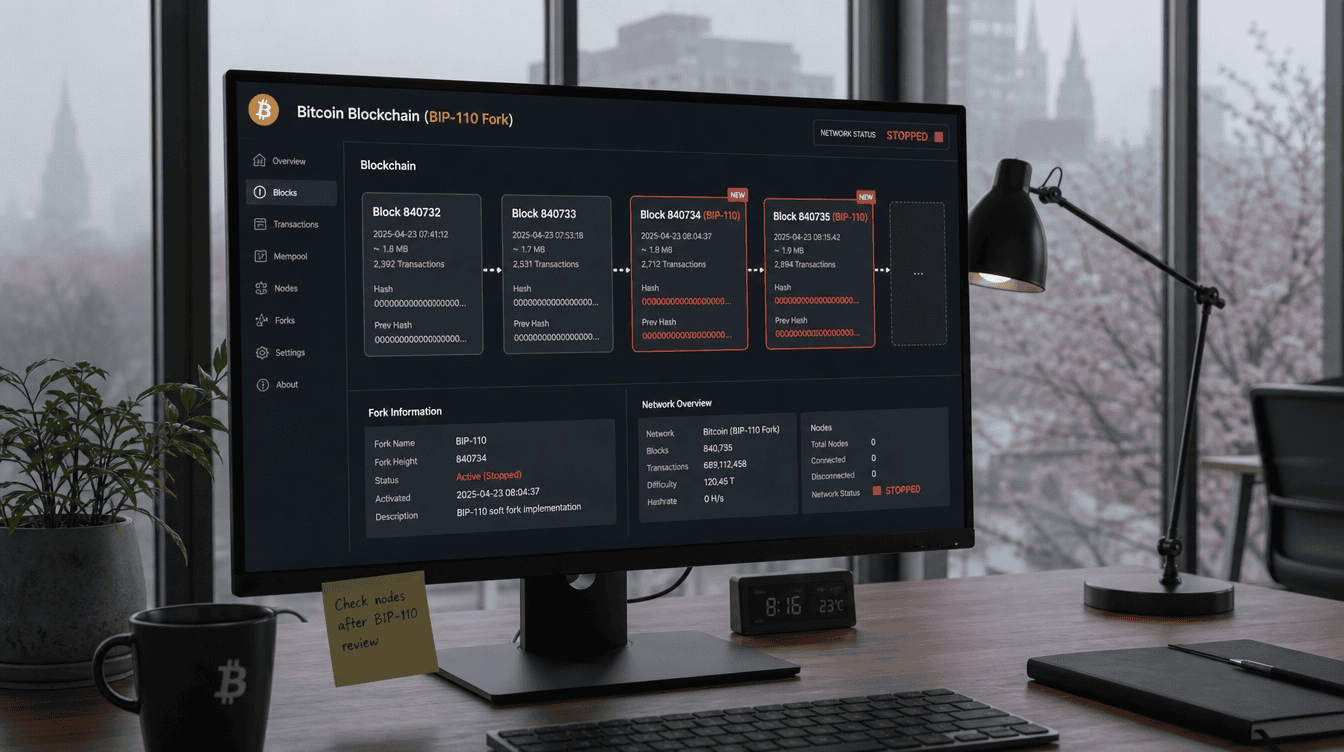
The breakaway chain carried over Bitcoin’s current mining difficulty despite having only a small share of the network’s hashpower, causing blocks to arrive hours apart even as both chains continue processing identical transactions.
Formed on Saturday when BIP-110 supporters split from Bitcoin, the minority chain has produced just two blocks in roughly eight hours, with no clear sign of sustained miner participation.
At about 6 a.m. UTC, the fork was at block 961,633, while the main Bitcoin chain had advanced to block 961,681, according to the BIP-110 monitor. The split occurred at block 961,632, when nodes running BIP-110 software began rejecting any block that did not signal support for the proposal.
Because Bitcoin typically adds a block every ten minutes, the 48-block gap represents nearly a full day of activity on the main chain and almost none on the fork.
BIP-110 (Bitcoin Improvement Proposal 110) seeks to block the use of Bitcoin transactions for storing non-financial data—such as images and text—for one year. Supporters say this reduces network congestion and lowers costs for users making genuine payments.
Opponents argue that anyone paying transaction fees should be free to use block space as they choose, and that miners or node operators should not decide what qualifies as a valid transaction.
AntPool mined the first non-signaling block, which was accepted by the main network but rejected by BIP-110 nodes. Meanwhile, a miner using Ocean produced the alternative block that the forked chain followed. (Miners use significant computing power to secure the network and process transactions, earning rewards and fees in return.)
Both AntPool and Ocean are mining pools, where multiple participants combine resources and share rewards.
The slowdown has a structural cause. Bitcoin recalibrates mining difficulty every 2,016 blocks to maintain an average block time of about ten minutes.
The fork inherited this difficulty level but lacks sufficient hashpower, resulting in long delays between blocks. It cannot lower the difficulty until it mines 2,016 blocks, which could take roughly 350 days at the current pace—compared with about 14 days for the main network.
Support for BIP-110 has been minimal, with only 2.53% of blocks signaling in favor over the past two weeks—well below the 55% threshold required for activation without a split.
This creates complications for trading the forked asset. Since both chains still accept identical transactions, a transaction on the fork can be replayed on the Bitcoin network, potentially allowing a buyer to claim real BTC from the same transfer—introducing a new attack risk.
At the same time, the fork’s slow block production means transactions take far longer to confirm, reducing its usefulness for trading.
BIP-110 nodes will require all blocks to signal support until block 963,647, but at the current pace, the chain is unlikely to reach that level within the two-week window.