cpeditor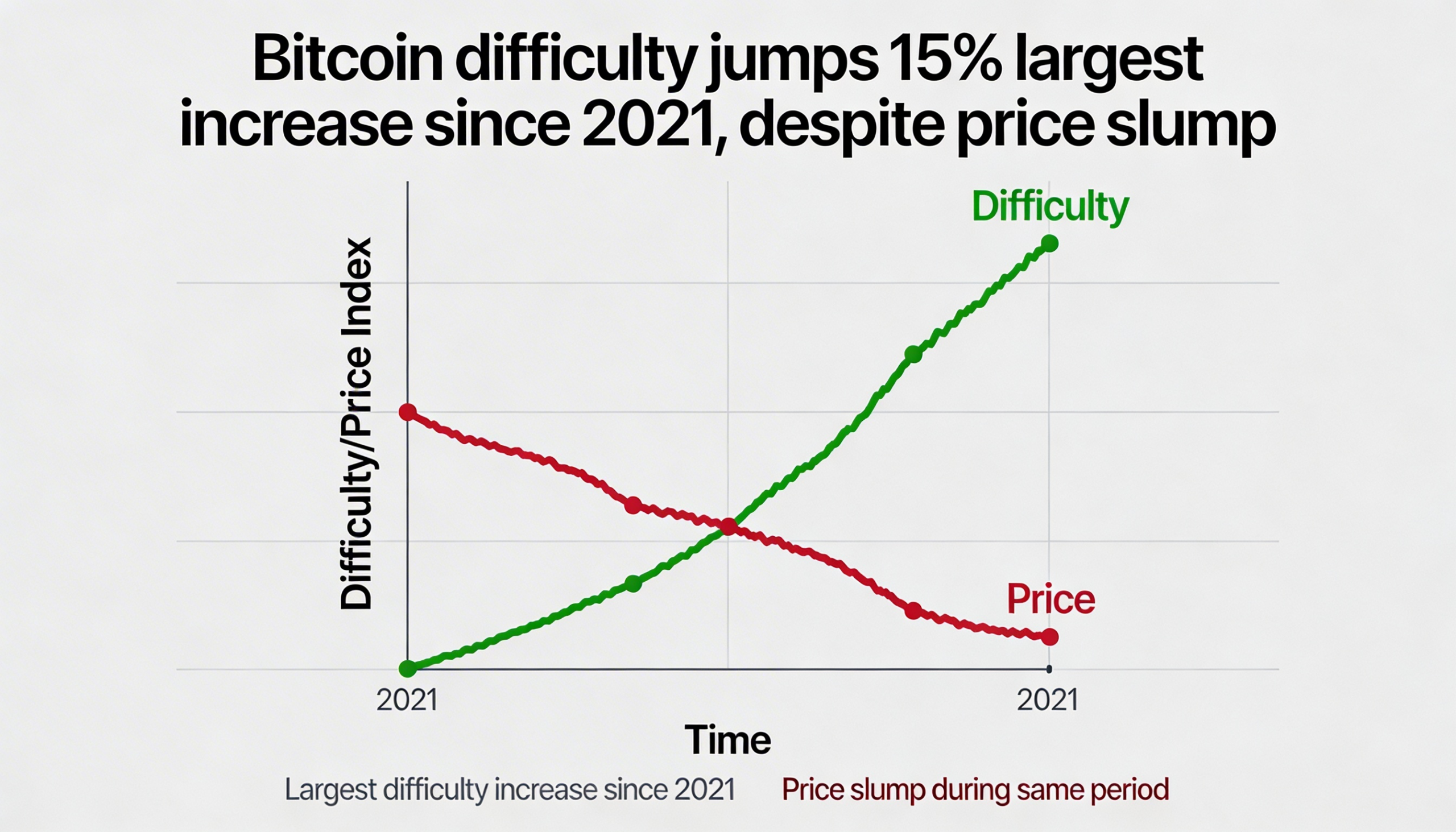
Bitcoin’s mining difficulty has surged to 144.4 trillion in the latest adjustment, a 15% increase that marks the largest percentage jump since 2021. The rebound comes as network hashrate climbs back to 1 zettahash per second (ZH/s), even though miner revenues remain compressed at multi-year low hashprice levels.
Mining difficulty, which determines how challenging it is to validate a new block, adjusts every 2,016 blocks — roughly every two weeks — to maintain Bitcoin’s 10-minute average block time. The sharp rise follows a 12% drop in the previous adjustment after a decline in overall network computing power.
That earlier slowdown represented the steepest hashrate pullback since late 2021, when a severe winter storm in the United States forced several major operators to curtail operations.
The network had previously reached peak strength in October, when bitcoin traded near an all-time high of $126,500 and hashrate hit 1.1 ZH/s. As prices slid to around $60,000 in February, hashrate fell to 826 exahash per second (EH/s). Since then, computing power has rebounded to 1 ZH/s, while bitcoin’s price has recovered to approximately $67,000.
Even with the recovery in hashrate, miner profitability remains under pressure. Hashprice — a metric tracking estimated daily revenue per unit of hashrate — is hovering near $23.9 per petahash per second (PH/s), among the weakest levels seen in years.
Despite squeezed margins, large-scale miners with access to low-cost and stable energy sources continue operating aggressively. The United Arab Emirates, for example, is estimated to be holding roughly $344 million in unrealized profit from its mining operations.
Well-capitalized and energy-efficient players are helping keep the network resilient, sustaining elevated hashrate levels even as bitcoin trades below its prior highs.
At the same time, the industry is undergoing a strategic shift. Part of the recent hashrate decline has been attributed to several publicly listed mining firms redirecting energy capacity toward artificial intelligence (AI) and high-performance computing (HPC) data centers.
Bitfarms (BITF) recently announced a rebrand that distances the company from a purely bitcoin-focused identity as it increases its emphasis on AI infrastructure. Meanwhile, activist investor Starboard has pushed Riot Platforms (RIOT) to accelerate its expansion into AI data center operations, underscoring a broader trend of diversification across the mining sector.