cpeditor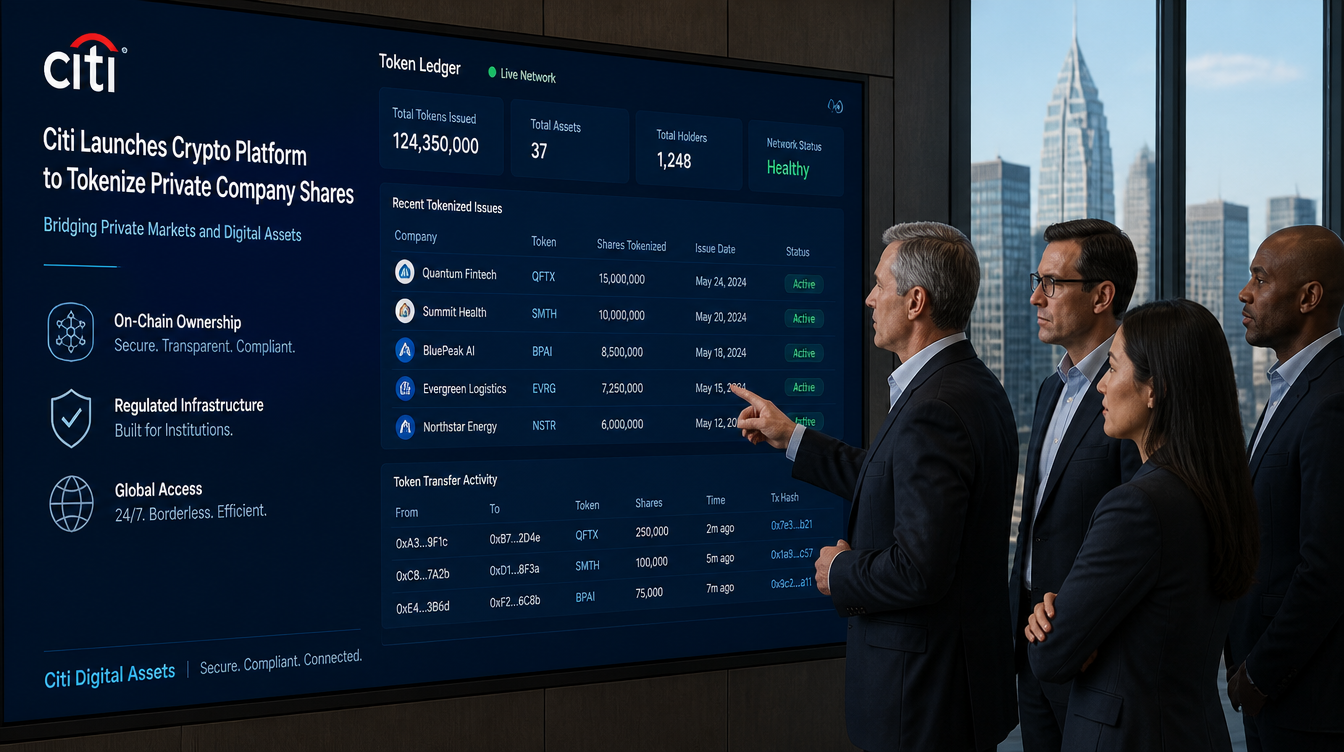
Citi News: Citigroup Rolls Out Tokenization Platform for Private Company Shares
Citigroup has launched a new crypto-focused platform aimed at tokenizing and trading shares of late-stage private companies for institutional and eligible investors. The project is being built in collaboration with SDX, the digital asset arm of the SIX Swiss Exchange, using a permissioned distributed ledger system.
In this structure, Citi will function as both custodian and tokenization agent, issuing securities in the form of regulated tokenized depositary receipts held within traditional financial institutions. The bank is already in active discussions with several large private companies to join the platform.
At launch, the service will be limited to non-U.S. investors, with U.S. access expected later once regulatory approval is secured. The platform is designed to tap into the estimated $75 billion late-stage pre-IPO equity market, which has expanded as high-profile firms such as SpaceX and Anthropic remain private longer, limiting secondary liquidity options for institutional investors.
Citi Tokenization Stack: SDX and R3 Corda Power Institutional Infrastructure
The platform is built on R3’s Corda permissioned distributed ledger, integrated through SDX’s central securities depository infrastructure under the SIX Group. Unlike public blockchain systems, it operates within a regulated institutional environment designed for compliance, custody, and settlement of traditional financial assets.
Citi issues tokenized depositary receipts while retaining custody of the underlying securities. Distribution at launch will be handled through Sygnum Bank in Switzerland and SBI Digital Markets in Singapore, targeting institutional and qualified investors across Europe and Asia.
According to Citi’s digital assets leadership, the goal is to place private company equity alongside public equities like Apple in a unified investment environment, allowing investors to access both asset classes with similar ease.
The platform also addresses long-standing inefficiencies in private markets, where trading processes are typically slow, manual, and reliant on fragmented ownership records. Citi states that tokenization on SDX infrastructure enables significantly faster, near real-time settlement compared to traditional workflows.
Tokenization Outlook: Citi Backs Growth Toward Multi-Trillion-Dollar Market
Citi’s Tokenization 2030 outlook estimates that tokenized real-world assets could scale to $5.5 trillion by 2030, up from around $17 billion today. Growth is expected to be driven primarily by private equity, real estate, and money market instruments, with projections ranging from $2.7 trillion to $8.2 trillion depending on regulatory progress.
Despite fluctuating institutional sentiment, major banks continue investing in infrastructure, signaling long-term conviction in tokenization rather than short-term experimentation.
Competition across Wall Street is also accelerating. JPMorgan, Bank of America, and Citi are jointly working on a tokenized deposit network via The Clearing House, targeting a 2027 launch to compete with stablecoin settlement systems. The New York Stock Exchange is also developing its own tokenized securities platform for late 2026, while DTCC has already begun limited live testing ahead of broader rollout.
Together, these efforts indicate that tokenization is transitioning from pilot programs into live financial infrastructure. Citi’s SDX-based platform places it directly within the emerging institutional ecosystem for private equity tokenization, particularly as demand grows for exposure to private markets amid delayed IPOs and shifting capital allocation trends.