cpeditor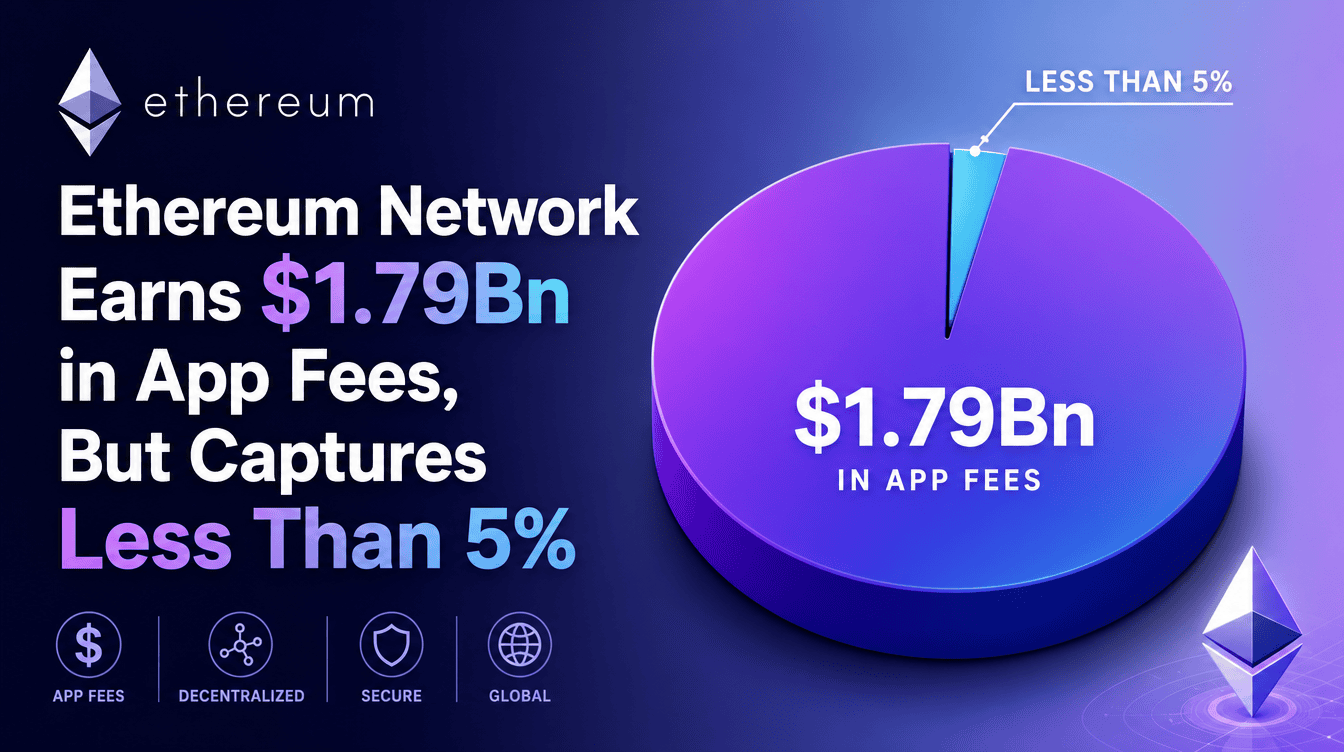
Ethereum’s application ecosystem generated $1.79 billion in fees during Q2 2026, while layer-2 networks processed nearly 1,270 user operations per second and tokenized real-world assets on the network reached $17.2 billion.
Despite these signs of growing adoption, ETH has struggled to reflect that progress in its price. The token remains below $2,000, around 60% lower than its all-time high near $4,950 recorded in August 2025. While Ethereum activity continues to expand, the amount of value captured by ETH itself has fallen behind, becoming one of the ecosystem’s biggest unresolved issues.
On-chain analyst @Tanaka_L2 detailed the gap in a July 31 analysis, showing that Ethereum’s layer-1 retained only 4.9% of the economic value generated by applications built on the network during the second quarter.
Ethereum’s mainnet produced $88.4 million in Real Economic Value, while applications running on top of the network generated $1.79 billion. This imbalance has contributed to ETH’s weaker performance against both historical benchmarks and Bitcoin, which has declined about 11% in 2026 compared with ETH’s roughly 32% drop.
The decline in ETH’s value capture is largely tied to structural changes within Ethereum’s architecture. Layer-2 rollups have become the primary source of user activity, with Tanaka’s figures showing rollups processing around 1,270 user operations per second compared with just 20.4 on the Ethereum mainnet.
Blob Fees Reduce Pressure on ETH’s Burn Mechanism
Ethereum’s move toward rollup-based scaling has improved efficiency and lowered transaction costs, but it has also reduced the fee revenue that previously supported ETH’s supply reduction through burning.
The introduction of low-cost blob fees for L2 data availability has significantly reduced ETH burn activity. Over a seven-day period, blob fees accounted for only about 0.22 ETH burned, showing limited impact on overall supply dynamics.
With ETH supply growing at approximately 0.85% annually and staking rewards around 2.6%, the foundation of the “ultrasound money” narrative has weakened. The ETH/BTC ratio has fallen to multi-year lows as Bitcoin continues attracting steady institutional demand.
At the same time, Ethereum has faced challenges from ETF outflows and a lack of a strong near-term demand catalyst. Investors are increasingly focused on whether tokenization and institutional adoption can create new sources of ETH demand.
Ethereum’s Role Could Evolve Into a Settlement Layer
Tanaka argues that the traditional view of ETH as a fee-generating asset is outdated. Instead, he believes Ethereum’s future value could come from its role as reserve collateral and settlement infrastructure for institutional blockchain finance.
Under this model, growth in tokenized financial markets would increase demand for ETH through collateral requirements and settlement activity rather than relying primarily on retail transaction fees.
Ethereum currently supports a large financial ecosystem, with stablecoins worth roughly $299.4 billion and real-world asset tokenization reaching $17.2 billion.
Tanaka believes Ethereum’s strongest advantages are its institutional liquidity, trusted settlement environment, and the significant amount of ETH secured through staking. These factors could become increasingly important as traditional financial institutions adopt blockchain-based systems.
However, he outlined three major conditions needed for this thesis to drive ETH demand:
- Layer-2 growth must create meaningful demand pressure for Ethereum’s limited throughput resources.
- Stablecoins and tokenized assets must experience active usage and turnover rather than remaining largely inactive.
- Institutions must begin holding ETH as a reserve asset instead of only using the network.
So far, these developments have not reached the scale required to significantly change Ethereum’s economic model.
Ethereum’s Long-Term Challenge: Turning Activity Into Value
The future of ETH depends on whether increasing blockchain activity can eventually translate into stronger revenue for Ethereum’s base layer.
If growth in real-world asset settlements and stablecoin transactions pushes demand for blob space beyond available capacity, Ethereum could see renewed fee generation and stronger ETH burn dynamics.
That outcome would allow Ethereum’s scaling strategy to benefit the token’s economics. However, if the network continues expanding while L1 fees remain suppressed, concerns around ETH’s value capture could persist and continue weighing on the ETH/BTC ratio.
Ethereum’s short-term price performance is also being affected by broader market trends. ETH remains more closely correlated with Nasdaq than Bitcoin and currently lacks a major catalyst capable of directly addressing its revenue capture challenge.
Tanaka describes the current phase as a deliberate period of economic compression, where Ethereum has prioritized ecosystem growth and affordable execution while postponing stronger returns for the base layer.
The central market debate is whether this delayed value capture will eventually lead to a significant ETH repricing or become a lasting feature of Ethereum’s modular architecture.