cpeditor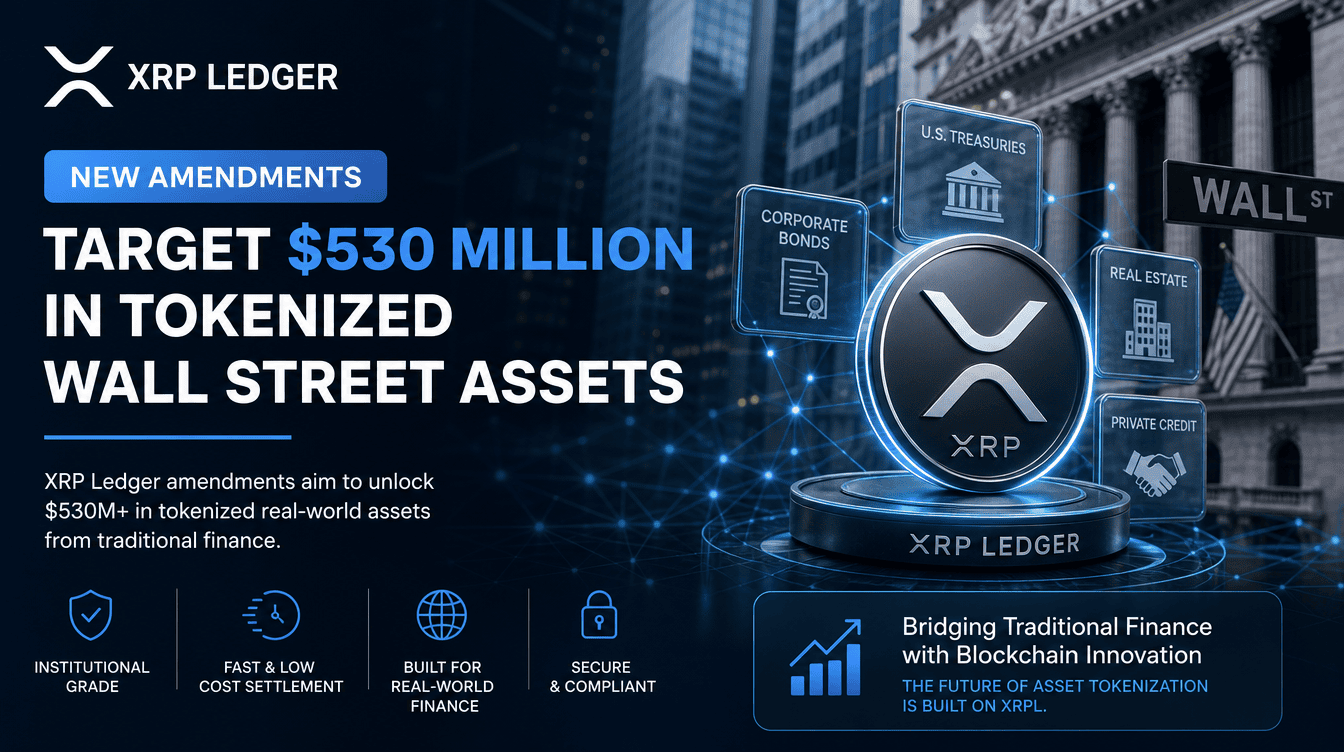
A new proposal for the XRP Ledger (XRPL) could give institutions the ability to shield token balances and transaction sizes, while still allowing controlled access for issuers, auditors, and regulators.
The feature, designed with institutional finance in mind, is now heading to a vote on XRPL, where more than $530 million in tokenized real-world assets are already on-chain.
XRPL version 3.3.0, released this week, introduces six proposed amendments. Among them, “Confidential Transfers” stands out as the most relevant for institutional users. It enables the encryption of balances and payment amounts for Multi-Purpose Tokens (MPTs), a format Ripple has been promoting for assets such as funds, bonds, and other financial instruments.
The aim is to let institutions move assets without disclosing the size of their positions or transfers. While wallet addresses and token types remain visible, the underlying values can be hidden.
Even so, the network can still validate transactions using cryptographic proofs, ensuring that everything balances correctly without revealing the actual figures.
Ripple has spent much of 2026 pushing XRPL further into the tokenized finance space. Last month, Aviva Investors launched a tokenized share class of its U.S. Dollar Liquidity Fund on the ledger, following a partnership announcement earlier this year.
There is already significant capital on the network. Data from RWA.xyz shows roughly $1.38 billion in tokenized real-world assets on XRPL, including $845.7 million in RLUSD. Ondo accounts for $212.6 million, followed by VERT Capital at $116.1 million, Archax at $55.4 million, and Societe Generale at $11.6 million.
Excluding RLUSD, that leaves more than $530 million in other tokenized assets on XRPL, though the market remains concentrated among a handful of issuers.
In its initial rollout, Confidential Transfers will be limited. Participation is optional, and the feature currently supports only direct MPT transfers between accounts. It does not yet extend to XRPL’s built-in exchange, escrow, or check functionality.
The remaining five amendments also target institutional use. “Batch” allows up to eight transactions to be grouped together, including an all-or-nothing execution option. “Sponsor” enables one account to cover another’s fees and reserve requirements, removing the need for new users to hold XRP.
“Permission Delegation” allows accounts to grant limited transaction authority to third parties without giving up full control, while “Dynamic MPT” lets issuers modify certain token properties after issuance.
Version 3.3.0 also includes performance improvements and bug fixes. According to XRPL Operations, it reduces memory usage by 10% to 15% and improves node synchronization speeds.
None of the amendments are live yet. XRPL changes require at least 80% approval from trusted validators, sustained over two weeks, before activation.
Confidential Transfers must first pass that threshold. Afterward, the key question will be whether institutions such as Aviva or Ondo adopt the privacy feature or continue operating with fully transparent transactions.