cpeditor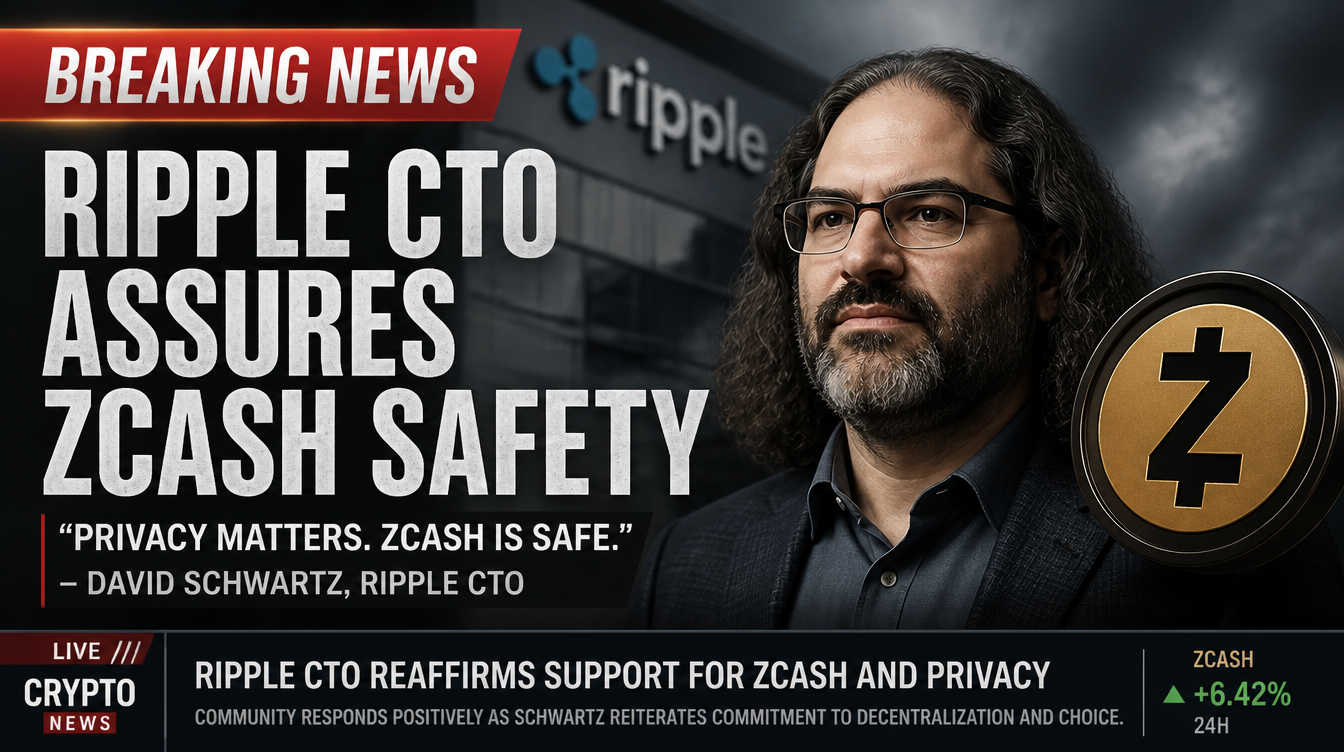
Ripple CTO Emeritus David Schwartz addressed the Zcash situation on June 7, offering a cautious note of reassurance to ZEC holders following the disclosure of a critical vulnerability in the Orchard shielded pool.
His core message: holders who leave their coins untouched are unlikely to lose funds—so long as the flaw was never exploited. That qualifier, however, is doing most of the heavy lifting.
At the center of the issue is a structural paradox. The Orchard bug—patched through an emergency NU6.2 hard fork on June 2—may have enabled the undetectable creation of counterfeit ZEC for nearly four years.
Because of Zcash’s privacy-first design, its developers cannot conclusively prove whether the exploit was ever used. The same cryptography that protects transaction anonymity also prevents full supply verification. Schwartz’s reassurance is technically accurate, but it cannot amount to a guarantee.
Markets reacted accordingly. After the May 29 disclosure, ZEC dropped more than 30% in a single session, briefly hitting a multi-week low.
Crucially, the sell-off was not driven by confirmed exploitation, but by the inability to rule it out—a form of risk that is far harder to price.
What Schwartz’s remarks actually mean for holders—and whether they alter the broader structural outlook—is the key question.
Discover: The Best Crypto to Diversify Your Portfolio
Inside the Orchard Bug: What It Means for ZEC
The Orchard pool, introduced with Network Upgrade 5 (NU5) in May 2022, represents Zcash’s most advanced privacy layer. Built using Halo 2-based zk-SNARKs, it eliminated the need for trusted setups required by earlier systems.
The vulnerability stemmed from an under-constrained element in the elliptic-curve multiplication logic within the halo2_gadgets library. In practical terms, this flaw allowed specially crafted inputs to bypass verification and generate counterfeit ZEC that would still appear valid on-chain.
Zcash engineer Taylor Hornby identified the issue on May 29, 2026, reportedly with the aid of AI-assisted formal verification. He confirmed a working exploit in a local testing environment and noted that deploying it on mainnet could have produced unlimited, undetectable ZEC.
The exposure window stretched from Orchard’s mainnet launch in May 2022 through June 1, 2026—nearly four years. Affected components included halo2_gadgets versions before v0.5.0, orchard before v0.14.0, and zcashd releases from v5.0.0 to v6.12.3.
Developers moved quickly. An emergency soft fork (Zebra 4.5.3) temporarily disabled Orchard transactions, followed by the NU6.2 hard fork via Zebra 5.0 on June 2.
The flaw has now been fixed. However, the critical limitation remains: while the patch prevents future abuse, it cannot retroactively verify whether the ZEC supply was compromised during the affected period. That uncertainty is permanent.
Schwartz’s Take: Accurate, But Not Absolute
The issue gained wider attention after crypto commentator Nate (@satorinakamoto on X) questioned whether Zcash could ever prove the exploit had not been used.
Schwartz, a co-creator of the XRP Ledger and a respected technical voice, responded by emphasizing that holders would retain access to their funds—even as the Orchard pool is phased out, coins would remain safe and spendable.
His broader argument is that consensus rules safeguard ownership, and protocol updates can preserve backward compatibility, ensuring passive holders are not adversely affected.
The reassurance, however, is conditional. If no exploit occurred, then funds remain intact. But that condition is precisely what cannot be verified.
Shielded Labs acknowledged this directly, stating there is no cryptographic method to determine whether exploitation ever took place. While Schwartz’s analysis is logically sound, it cannot eliminate that uncertainty.
Both realities can coexist: the system may be secure in principle, yet unverifiable in practice. The market is reacting to that gap—and pricing it accordingly.
Discover: The Best Token Presales