cpeditor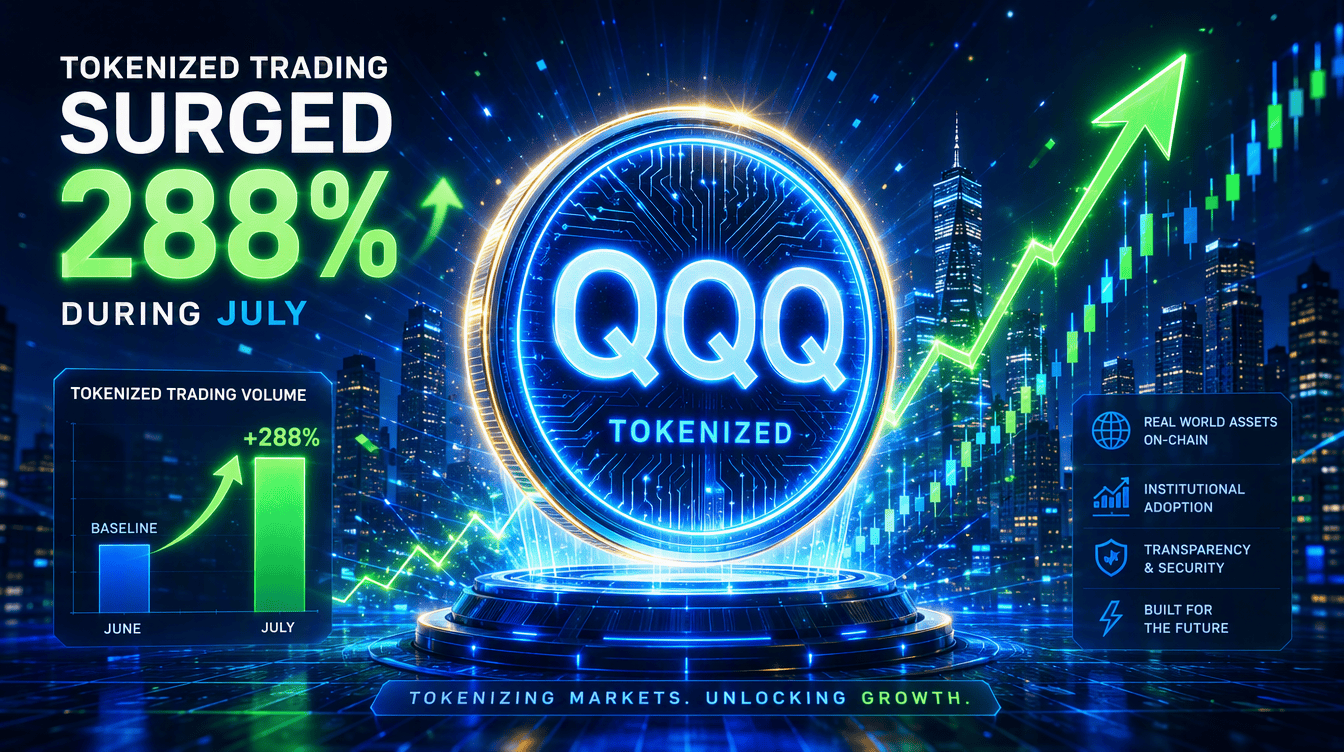
Excluding the QQQ-linked token QQQB, July’s tokenized equity trading volume would total about $2.03 billion—roughly 30% lower than June’s estimated $2.91 billion.
Overall, tokenized stocks and ETFs saw trading volume soar 288% to a record $11.3 billion in July, but the surge was overwhelmingly driven by a single Binance-linked product.
According to CoinDesk Data, Binance’s bStocks generated $9.41 billion, accounting for 83.3% of total activity. QQQB alone—tracking the Invesco QQQ ETF—contributed $9.27 billion, or about 82% of the entire market.
When QQQB is removed, the broader market appears significantly weaker. xStocks volume dropped to $335 million from $1.55 billion in June, while Ondo recorded $792 million and Backpack $479 million.
QQQB launched on Binance on June 30 with zero maker fees in place through Aug. 31. Beginning July 23, Binance also applied a 3x multiplier to stock and bStocks trades for certain users aiming for higher VIP tiers, though this did not affect actual trading volumes.
Meanwhile, the underlying Invesco QQQ Trust declined 6.6% in July, compared with a 3.2% drop in the Nasdaq Composite and a slight 0.1% decrease in the S&P 500. The ETF fell as much as 10.2% below its June 30 close before rebounding toward the end of the month.
Much of the volatility was tied to AI and semiconductor stocks. The iShares Semiconductor ETF dropped 22.1%, marking its worst month since December 2002, while Micron fell 28.7%, according to MarketWatch. Increased volatility driven by AI-related trading, the FOMC meeting, and big tech earnings contributed to heightened activity in QQQ.
A key appeal of tokenized equities is their 24/7 availability. By replicating traditional stocks on blockchain infrastructure, they allow continuous trading, giving international investors access outside U.S. market hours and in regions where direct brokerage access may be limited.