cpeditor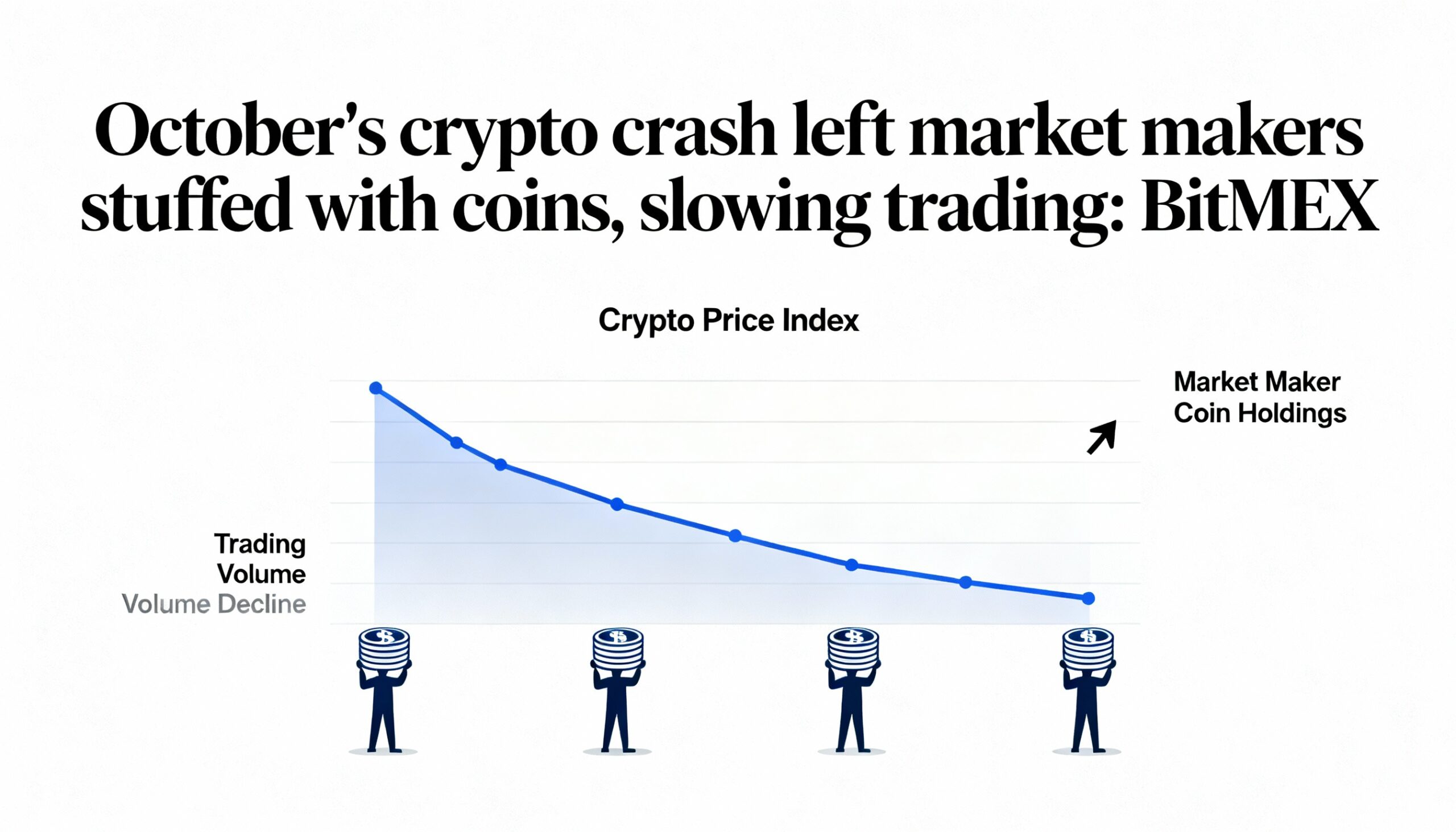
BitMEX Report: October Crypto Crash Drains Liquidity, Hits Market Makers
The October 2025 crypto crash did more than wipe out billions—it disrupted market mechanics. Market makers, who keep trading orderly, were left holding massive crypto positions, creating the thinnest liquidity conditions since 2022, according to BitMEX’s latest report.
Bitcoin fell from $121,000 to $107,000 on October 10, while altcoins such as XRP, ETH, and DOGE plunged even further. The volatility triggered $20 billion in leveraged futures liquidations across exchanges, marking an all-time high.
Auto-Deleveraging Amplifies Market Stress
Liquidations occur when leveraged trades move against holders, prompting exchanges to automatically close positions. On October 10, exchanges triggered auto-deleveraging (ADL)—closing even profitable positions when insurance funds couldn’t cover losses.
Market makers, normally running delta-neutral strategies that offset long spot positions with short futures, were hit hard. ADL forcibly closed their short futures, leaving them exposed with unhedged long spot holdings. This breach of neutrality forced many to pull back from liquidity provision, resulting in extremely thin order books.
“ADL forced market makers to hold naked spot positions in a free-falling market. Liquidity withdrawal produced the thinnest order books since 2022,” BitMEX said in State of Crypto Perpetual Swaps 2025.
The forced unwinding contributed to further price declines, with BTC briefly dropping to $80,000 by November 21. Prices have since recovered above $90,000, but liquidity remains fragile.
The Decline of “Risk-Free” Arbitrage
Delta-neutral funding rate arbitrage, once seen as “risk-free” money, has lost its appeal. The strategy profits from price gaps between spot and perpetual futures while avoiding directional risk. Widespread adoption, however, caused funding rates to collapse.
“Billions in automated hedging flows flooded order books, collapsing funding rates. By mid-2025, risk-free crypto yields fell below 4%, underperforming U.S. Treasuries,” the report said.
Previously, such trades could yield over 25%, showing how mass adoption has arbitraged away easy profits.
Exchanges, DeFi, and Market Risks
The report also exposed structural risks. Some exchanges froze or seized profits under “abnormal trading behavior” clauses, revealing aggressive B-book practices. Low-float listings and pre-market manipulation remained vulnerabilities, exemplified by the MMT incident, where coordinated actors cornered spot supply to squeeze perpetual positions.
DeFi venues like Hyperliquid are growing, but decentralization doesn’t prevent manipulation. The Plasma ($XPL) incident showed that even on-chain transparency can’t fully protect users from exploitative liquidation strategies.
Finally, crypto derivatives have become a major venue for leveraged trading of traditional assets. Trading of U.S. stocks like Nvidia and Tesla outside standard hours surged, with crypto exchanges emerging as the primary platform for speculative activity, particularly ahead of earnings announcements.