cpeditor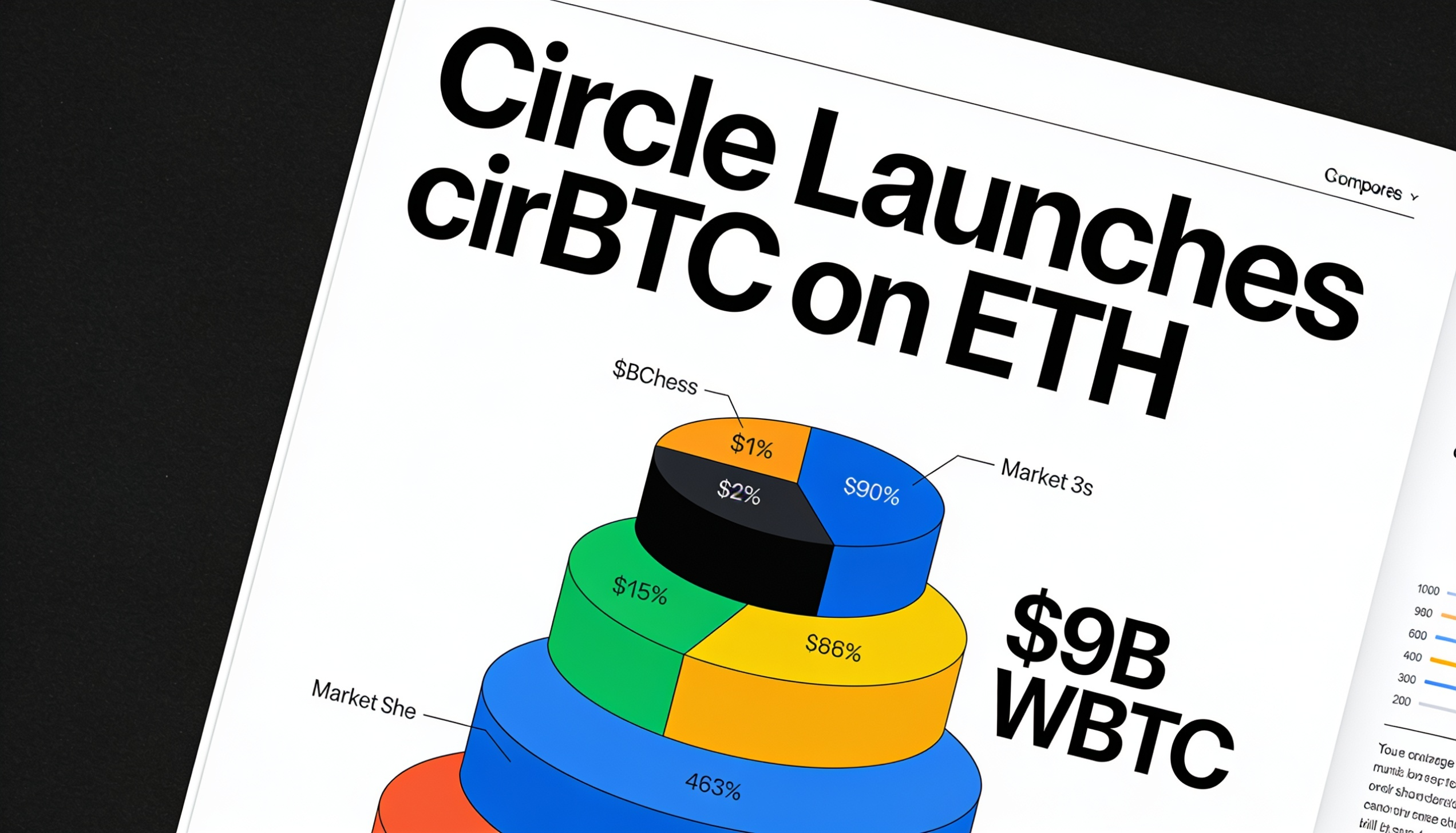
Here’s a tighter, more editorial rewrite with improved flow and reduced repetition:
Circle has launched cirBTC, a 1:1 Bitcoin-backed ERC-20 token on Ethereum, directly entering the competition against WBTC, which currently dominates the wrapped Bitcoin market with roughly $9 billion in value and around 85% share. The key differentiator is Circle’s promise of real-time, on-chain reserve verification without reliance on third-party attestations.
Released on June 8, 2026, cirBTC is aimed squarely at institutional users—including OTC desks, market makers, lenders, and DeFi protocols—seeking Bitcoin exposure as collateral within Ethereum-based applications.
The market is already competitive. WBTC, launched by BitGo in 2019, remains the dominant player, while cbBTC from Coinbase, introduced in 2024, has quickly become the strongest challenger, reaching approximately $5.9 billion in market value.
Circle is positioning cirBTC as a transparency-first alternative, leveraging its established credibility from USDC issuance and institutional-grade infrastructure.
Real-Time Proof of Reserves
cirBTC’s key innovation is its use of Chainlink Proof of Reserve, enabling continuous verification of BTC backing on-chain. Each token minted corresponds to Bitcoin held in segregated, regulated custody, with reserve data publicly verifiable across wallet addresses on the Bitcoin blockchain.
This removes reliance on periodic audits, custodial disclosures, or delayed attestations.
In contrast, WBTC depends on BitGo as the sole custodian, with transparency provided through published wallet addresses and governance-controlled multisignature structures. While functional, it remains more centralized compared to cirBTC’s automated verification model.
Concerns around custodial opacity following earlier bridge failures such as RenBTC have intensified demand for more transparent alternatives. Circle is directly targeting that gap.
Importantly, Bitcoin reserves backing cirBTC remain fully segregated from Circle’s corporate assets, with issuance and redemption handled via Circle Mint, its institutional liquidity platform. This extends the same infrastructure used for USDC into Bitcoin-backed tokenization, enabling institutions to deploy BTC in DeFi without selling their underlying holdings.
A $15–20B Market in Transition
The total tokenized Bitcoin market is currently valued between $15–20 billion, still less than 2% of Bitcoin’s total $1.7 trillion market cap. While small in relative terms, it is widely viewed as an early-stage but rapidly expanding sector.
WBTC leads with roughly $8–9 billion in circulation, while cbBTC holds about $5.9 billion and continues to grow quickly. The remaining share is split among exchange-issued wrapped BTC products from platforms like Kraken, Binance, Bitget, and OKX.
Circle’s entry does not immediately reshape market dominance, but it introduces a major institutional-grade issuer with global distribution capabilities—something most exchange-backed tokens cannot fully replicate.
A defining advantage for cirBTC is neutrality. Unlike exchange-issued wrappers, Circle does not operate a trading venue, lending platform, or DEX. This separation reduces conflict-of-interest concerns and limits information leakage for institutional users.
For hedge funds, market makers, and prime brokers, that isolation between custody and trading infrastructure is a meaningful advantage when deploying capital at scale.