cpeditor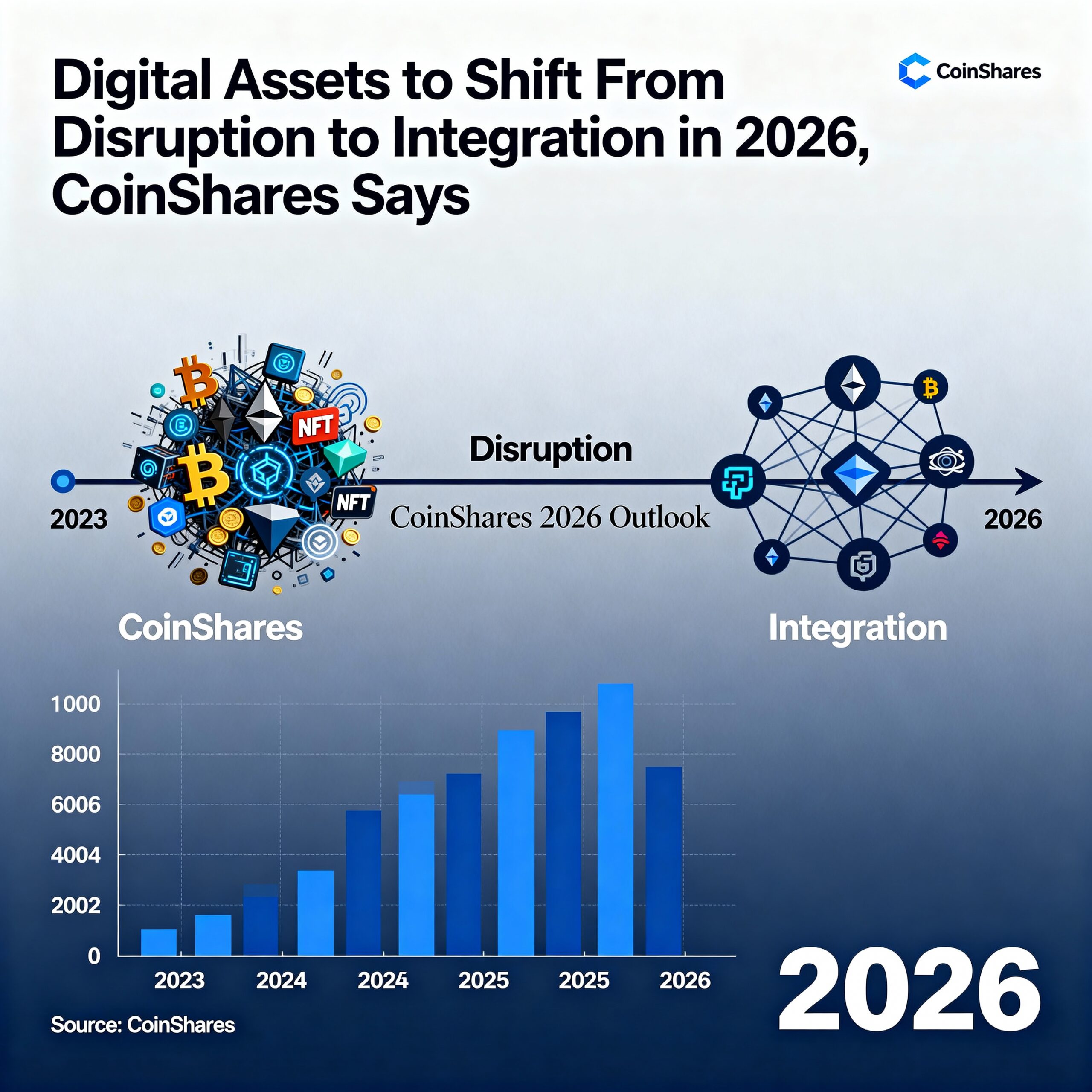
Crypto asset manager CoinShares says digital assets are transitioning from an experimental fringe to a foundational layer of the financial system as large institutions increasingly build on public blockchains.
In its 2026 Digital Asset Outlook published Monday, the firm argued that the next phase of crypto adoption will focus on convergence, not disruption, coining the term “hybrid finance” to describe the integration of crypto rails with traditional finance to create new market infrastructure.
“Digital assets are no longer operating outside the traditional economy,” CoinShares CEO Jean-Marie Mognetti said, adding that 2026 is likely to bring “consolidation into the real economy.”
The report highlights this integration in several areas, including stablecoin adoption and the growth of tokenized assets, particularly in private credit and U.S. Treasuries. It also notes expanding tokenized funds, tokenized deposits, and stablecoin launches from incumbent financial institutions.
Bitcoin’s mainstream adoption is accelerating as well, with more than $90 billion in U.S. spot ETF inflows and over one million BTC held by corporate treasuries across 190 public companies, according to the report.
For 2026, CoinShares anticipates broader access through wealth management platforms and retirement accounts, along with more direct institutional settlement via custody banks.
The firm outlines three potential bitcoin price scenarios tied to macroeconomic conditions:
- Soft landing with productivity gains: BTC could rise above $150,000.
- Steady but muted growth: Prices may range from $110,000–$140,000.
- Stagflation or recession: Short-term weakness could occur, followed by a potential rebound.
Competition to become the settlement layer for hybrid finance is intensifying, with Ethereum remaining the institutional anchor even as rivals gain traction.
“2026 will be defined by a financial system quietly rearchitecting itself around public blockchains and digital settlement layers,” said James Butterfill, CoinShares head of research.
The report also highlights widening regulatory divergence—from Europe’s MiCA framework to evolving U.S. stablecoin policy and Asia’s Basel-style approach. Other structural shifts include miners moving into high-performance computing and AI infrastructure, as well as prediction markets gaining mainstream relevance.