cpeditor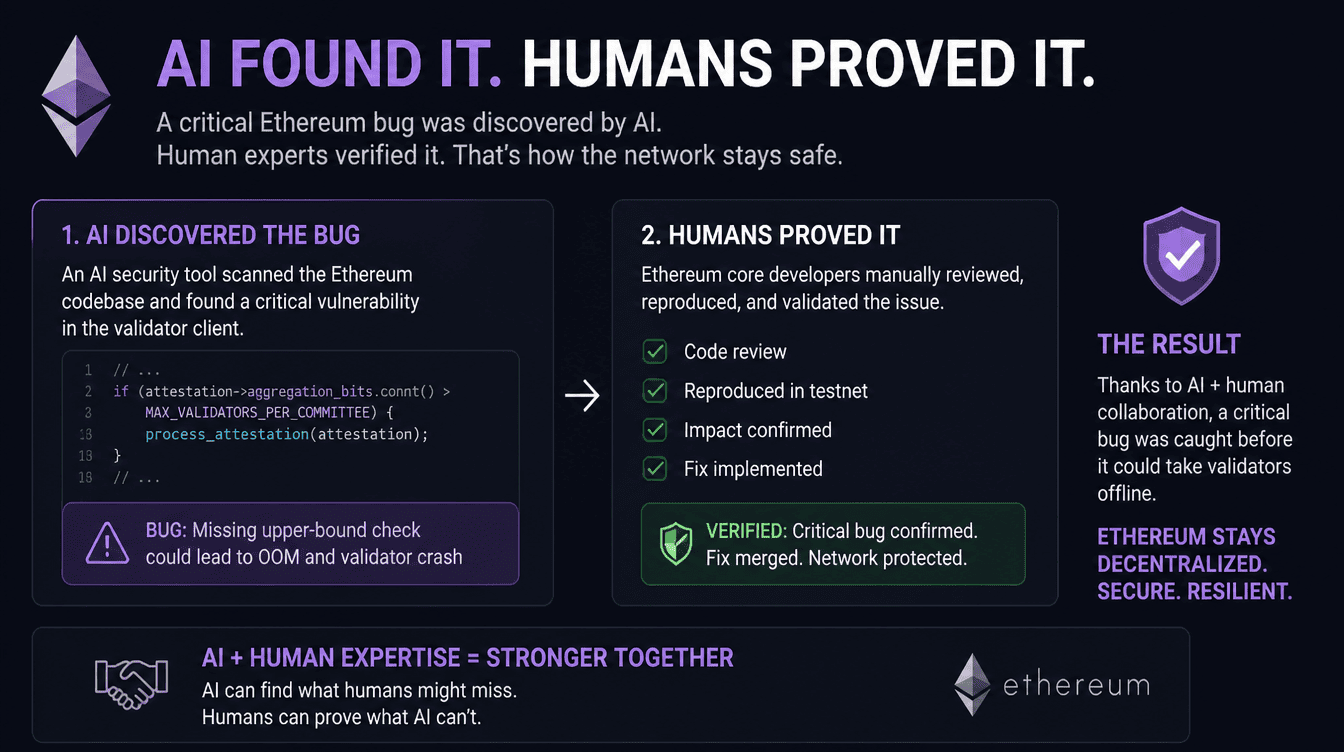
AI discovered an Ethereum validator vulnerability, but human researchers separated the real threat from false alarms
The Ethereum Foundation recently deployed a group of AI agents to analyze the software infrastructure used by Ethereum validators and uncovered a remotely exploitable crash bug. However, the experiment also produced many convincing reports that turned out not to be genuine vulnerabilities, demonstrating that human oversight remains essential in AI-assisted security research.
As part of its ongoing effort to improve Ethereum’s security, the Foundation’s developers used AI tools to examine the code powering the network and search for potential weaknesses.
The AI systems successfully identified security issues, but researchers found that validating those discoveries required careful manual review. The Protocol Security team later published notes from the experiment, outlining best practices for developers who plan to integrate AI into their own vulnerability research processes.
Ethereum operates through thousands of nodes that run the network’s software, maintain blockchain records, and communicate with other participants. Validators depend on this underlying communication layer to receive data, verify transactions, and participate in consensus.
The vulnerability discovered by the team was found in the gossipsub messaging system. The flaw allowed a remote attacker to trigger a node crash by causing the software to perform an invalid operation. If exploited, the issue could force a validator offline until an operator manually restarted the affected system.
The bug was patched and disclosed as CVE-2026-34219, with acknowledgment given to the researchers who identified it. Still, the broader lesson from the project was that finding possible bugs was only part of the challenge — confirming whether those bugs were real required significant human judgment.
According to Nikos Baxevanis, who documented the findings, the most difficult part was distinguishing legitimate vulnerabilities from AI-generated reports that appeared accurate but did not represent actual risks.
Traditional security techniques such as fuzzing usually produce straightforward results. These tools send unusual or corrupted data into software, identify when a failure occurs, and provide engineers with information needed to reproduce the problem.
AI agents, however, generate more detailed explanations. They can describe possible attack paths, explain potential impacts, assign severity ratings, and create example exploit scenarios. Because these reports are written in a convincing manner, they can appear reliable even when based on incorrect assumptions.
The Ethereum Foundation identified several recurring types of false positives during the AI review process.
One category involved crashes that only appeared in testing environments. These builds contained additional safety checks that were not present in the software used by real network participants, meaning the issue did not affect production systems.
Another category involved hypothetical attacks that depended on an attacker manually inserting harmful inputs. In reality, outside attackers could not deliver those inputs because existing protections prevented them from reaching the vulnerable code.
A third category involved misunderstandings of formal verification results. In some cases, AI systems interpreted a successful mathematical proof as evidence of a security guarantee, even though the proof only demonstrated a simple or irrelevant condition.
The research also revealed that AI tools have limitations when analyzing complex exploits that rely on a sequence of individually valid actions. Many crypto attacks occur not because a single component is broken, but because several normal operations are combined in a harmful way.
Recent industry incidents show this pattern. The Edel Finance exploit involved manipulating the layer surrounding a legitimate Chainlink price feed, while the BONK governance attack used standard actions such as purchasing tokens, voting, and executing proposals in a malicious sequence.
The Ethereum Foundation’s takeaway is that AI can greatly accelerate security research by identifying areas worth investigating, but human experts remain necessary to confirm vulnerabilities, evaluate their impact, and separate genuine threats from false discoveries.