cpeditor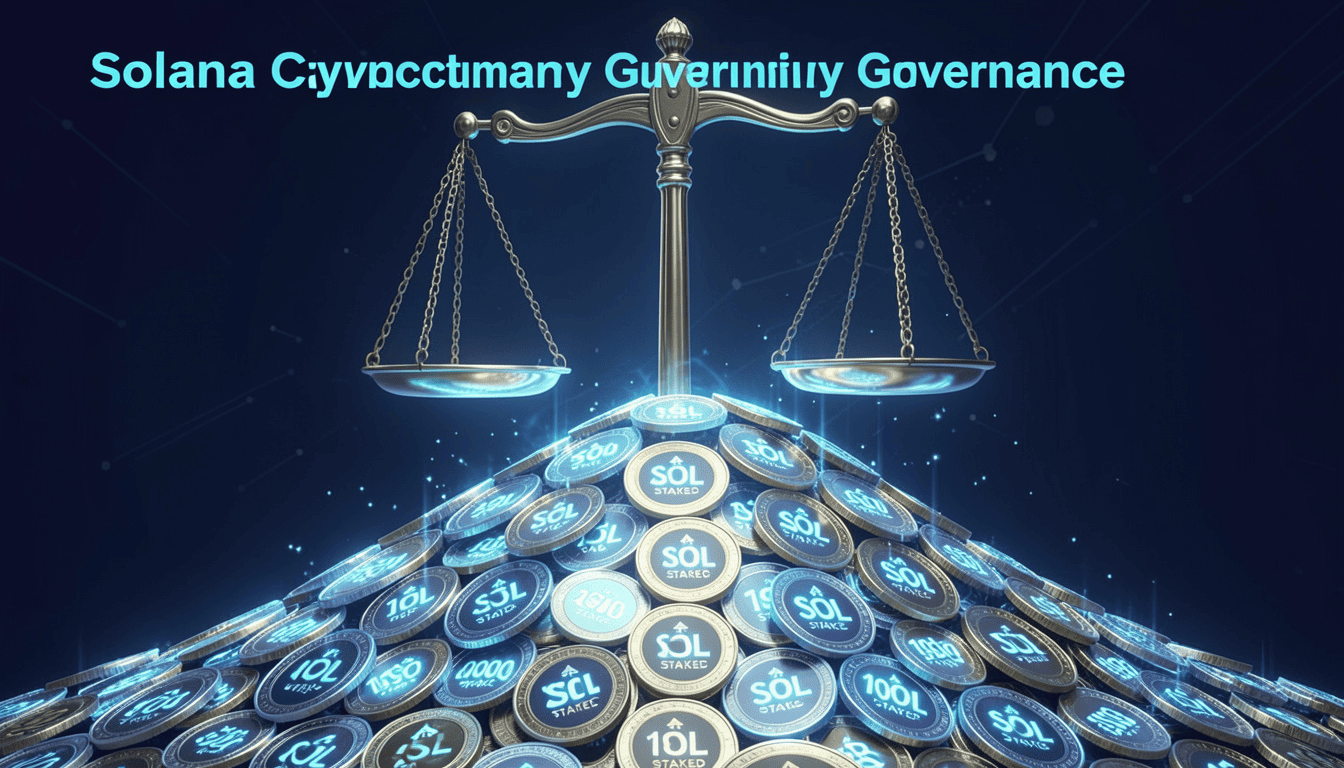
Solana has unveiled a formal onchain governance framework, introducing a new system called Solana Governance Proposals (SGPs) that allows validators and token holders to directly influence the network’s direction. Validators with at least 100,000 SOL staked can submit proposals, while delegators have the power to override their validator’s vote.
Outlined in the project’s GitHub repository, the model marks the first time Solana participants can cast transparent, onchain votes on key decisions affecting the protocol.
Under the SGP structure, validators backed by a minimum of 100,000 SOL (approximately $7.7 million) can propose high-level changes. Voting power is proportional to the amount of SOL staked, mirroring a shareholder-style system of governance.
Proposals are framed as simple, top-level questions about the network’s future direction. Votes are recorded onchain and verified through Merkle proofs, ensuring accurate results without requiring a full recount.
The system splits governance into two tracks. SGPs address whether a change should move forward, while Solana Improvement Documents (SIMDs) handle the technical execution and implementation details.
Approval of an SGP signals consensus to proceed, after which developers draft one or more SIMDs to carry out the change.
Proposals must first reach a 15% support threshold of active stake before progressing to a formal vote, a mechanism designed to filter out low-priority issues while allowing routine development work to continue uninterrupted.
Once the threshold is met, voting takes place across Solana’s epoch cycle, with each epoch lasting roughly two days.
For a proposal to pass, it must secure a two-thirds supermajority of participating stake, with abstentions excluded. There is no minimum turnout requirement.
A key feature of the framework is the expanded role of delegators — users who stake SOL with validators instead of running nodes themselves. They can override their validator’s vote or step in when a validator abstains, with voting weight tied to their individual stake.
The Solana Foundation refers to this model as “staker sovereignty,” ensuring governance power ultimately resides with token holders rather than being concentrated solely among validators.
The rollout coincides with renewed market interest in Solana, with SOL rising around 16% over the past week to near $78, outperforming much of the broader crypto market.