cpeditor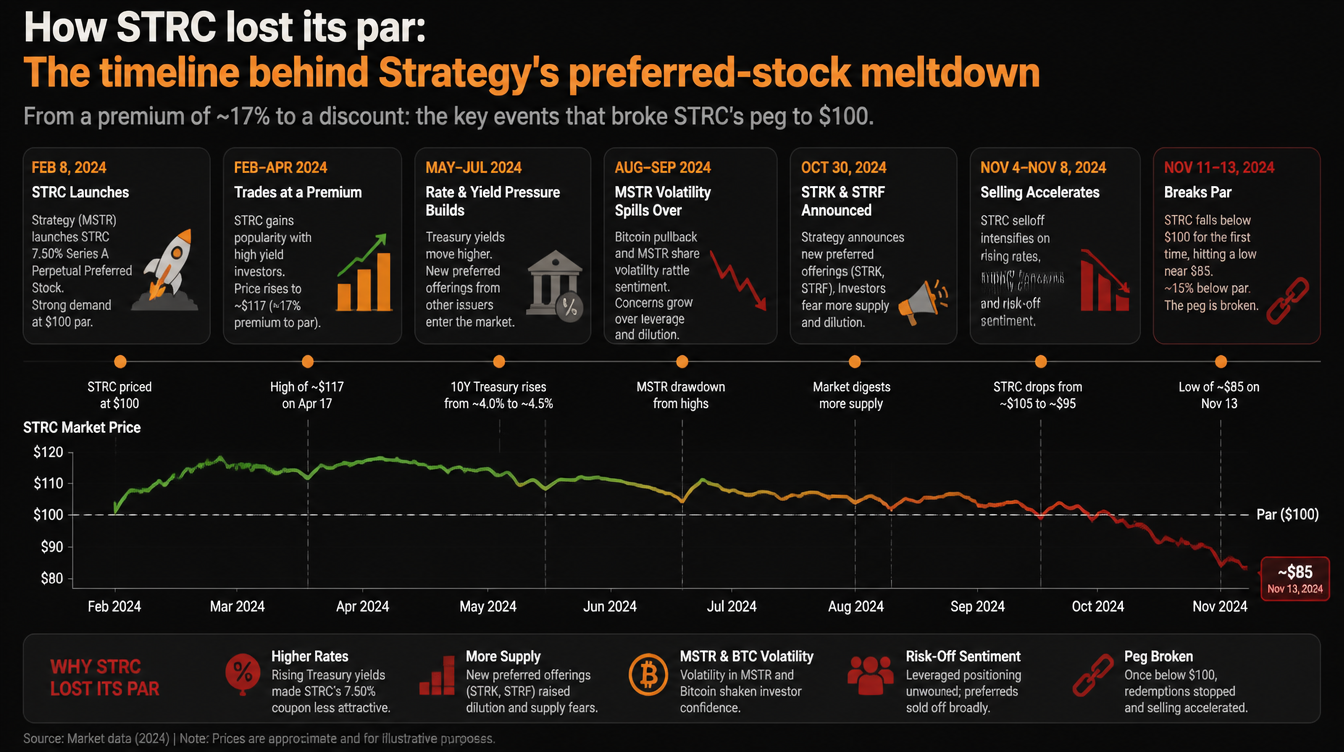
A mix of debt repurchases, declining liquidity buffers, and a weakening bitcoin market triggered the chain reaction that pushed STRC away from its $100 par value and into broader market focus.
STRC, the dividend-paying preferred stock issued by bitcoin treasury firm Strategy (MSTR), is structured to trade at par. In practice, however, maintaining that level has proven difficult.
On Thursday, the security dropped below $83—about 17% under its target and its lowest level since launching in July 2025. This is notable for an instrument marketed as both high-yield and low-volatility.
Holding close to par is essential for Strategy, as it allows the company to efficiently raise capital through at-the-market (ATM) offerings used to fund its 11.5% annual dividend.
In recent weeks, falling bitcoin prices and a series of strategic decisions have driven STRC significantly lower. The timeline unfolded as follows:
May 14: STRC closed at $100 ahead of its ex-dividend date, with bitcoin trading above $80,000, giving the appearance of stability. Beneath the surface, however, bitcoin was already well below its $126,000 peak, and STRC’s ability to hold par was largely limited to the pre-dividend window.
That same day, Strive Asset Management introduced daily dividends for its competing product, SATA, offering a higher 13% yield. This increased pressure on Strategy, which was seeking approval to shift STRC to semi-monthly payouts to reduce volatility.
May 15: Strategy announced a $1.5 billion buyback of its 2029 convertible notes at an 8% discount. The move was partly funded using a reserve originally set aside for dividends and debt obligations, though this was not disclosed at the time. Bitcoin slipped to $78,000.
May 18: Strategy purchased 24,869 BTC as prices continued trending lower toward $76,000.
May 26: The company confirmed the reserve had been used in the buyback, reducing it to $871 million—equivalent to roughly six months of dividend coverage, down from a previous target of 24 months. STRC traded at $99.33.
June 1: Strategy sold 32 BTC—its first sale since 2022—signaling a willingness to liquidate holdings if needed to support dividends. Although minimal, the move weighed on sentiment: MSTR fell 5.9%, and bitcoin dropped to around $71,000. STRC closed at $98.07.
June 5: Bitcoin fell below $60,000 for the first time since October 2024, closing near $61,000. STRC declined sharply, touching $90 before ending at $93.40.
June 8: Shareholders approved semi-monthly dividend payments. Strategy added 1,550 BTC and said reserves had recovered to $1 billion.
June 15: Another 1,587 BTC purchase lifted reserves further to $1.1 billion.
June 18: STRC fell below $83 intraday before closing at $88.59 ahead of a U.S. holiday. Bitcoin also reversed gains, slipping to $62,880. Market participants largely attributed the weakness to leverage-driven liquidations rather than a deterioration in credit fundamentals.
Strategy now holds 846,842 BTC at an average cost of $75,656, leaving it with an unrealized loss of approximately $11.1 billion at current prices.
At the same time, recent capital raises have been viewed as dilutive, drawing criticism from investors. MSTR shares are now trading near $112, down roughly 80% from their November 2024 peak.
All of this has unfolded against the backdrop of a bitcoin bear market, further eroding confidence not only in the asset but also in the financial structures built around it.
The central question now is whether STRC can stabilize and return to its $100 par value—or continue to face pressure from market and structural headwinds.