cpeditor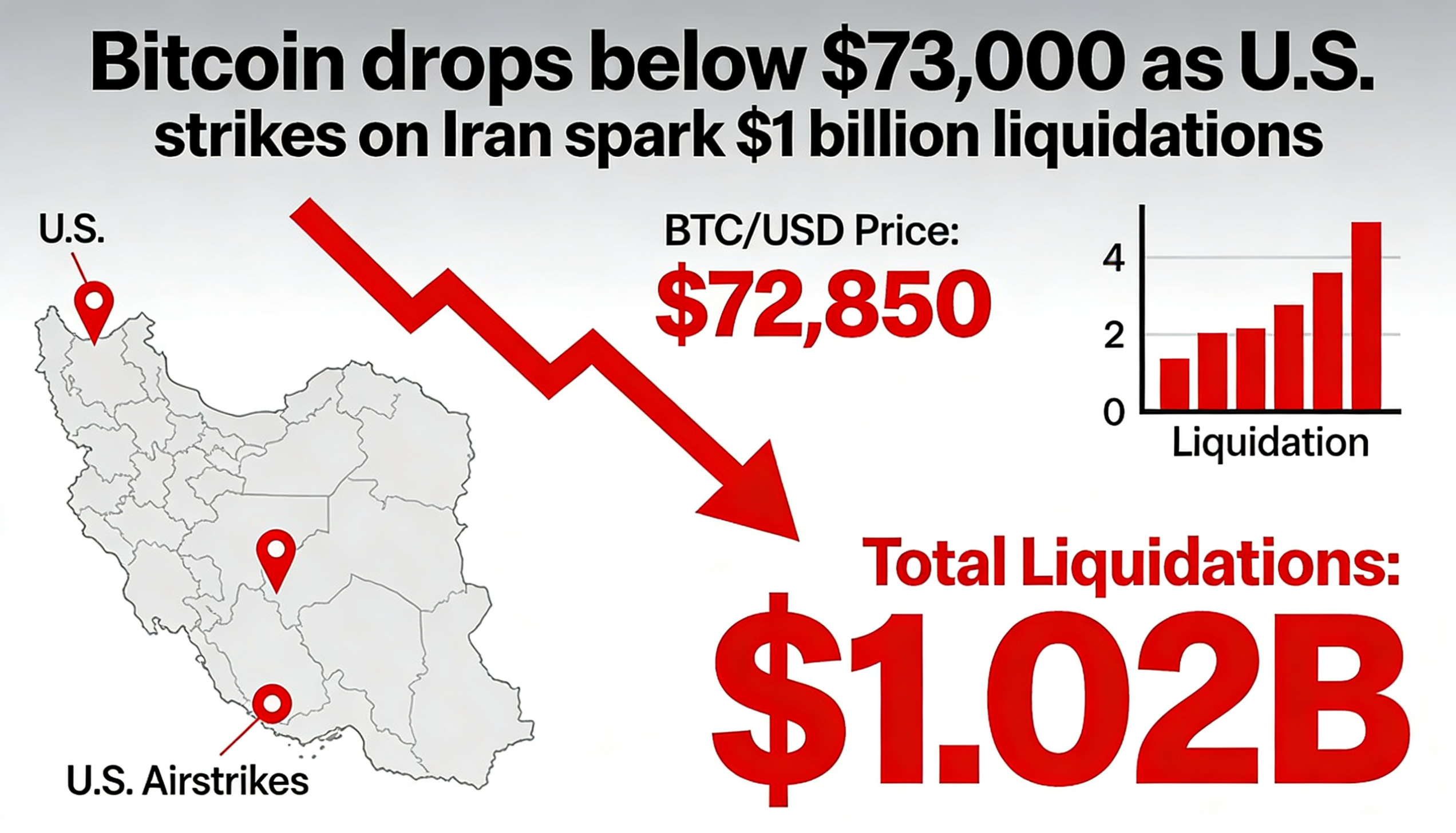
Bitcoin Breaks $73K Support as Geopolitical Shock Triggers $1B Liquidations
Cryptocurrency markets came under pressure after renewed U.S.-Iran tensions sparked a sharp unwind in risk assets, wiping out nearly $1 billion in leveraged positions. The sell-off followed U.S. airstrikes on an Iranian military site near the Strait of Hormuz, reintroducing geopolitical risk that investors had increasingly priced out.
Bitcoin slipped below the $73,000 level for the first time in months, accelerating losses across major digital assets and setting off one of the largest liquidation cascades of the year.
The asset traded at $72,978 during Thursday’s Asian session, down 3.4% on the day and 6.3% over the past week after touching an intraday low of $72,912, according to CoinDesk data. Ether dropped 4.2% to $1,976, falling back under the $2,000 threshold and extending weekly losses to 7.7%. Solana declined 3.5% to $80.57, XRP fell 3.6% to $1.28, while Dogecoin shed 3.2% to $0.0979.
Despite the broader weakness, Hyperliquid remained the only major token with a net weekly gain, holding up 2.4% over seven days even after a 4.5% daily drop. Tron also outperformed on a relative basis, maintaining a 1.9% weekly increase.
The move lower triggered widespread liquidations among leveraged traders. CoinGlass data showed $958.8 million in liquidations over the past 24 hours across 167,706 accounts, with long positions accounting for $897 million of the total, compared to $61 million from shorts.
Bitcoin led liquidation volumes at $386 million, followed by ether at $246 million. The largest individual liquidation was a $15.34 million Bitcoin position on Hyperliquid.
The imbalance — with roughly 93% of liquidations tied to long positions — reflects how heavily traders were positioned for a continued recovery. Leverage built during May’s range-bound trading was unwound rapidly as prices broke key support levels.
The catalyst originated in the Middle East. U.S. Central Command confirmed it carried out strikes on an Iranian military installation near the Strait of Hormuz and intercepted four attack drones targeting a commercial vessel. Officials characterized the operation as defensive, aimed at preserving a ceasefire established last month.
Tensions escalated further after the U.S. Treasury imposed sanctions on Iran’s Persian Gulf Strait Authority, accusing it of extorting vessels passing through the critical shipping route. Iran reportedly retaliated by targeting the U.S. airbase used to launch the strikes, according to reports citing the Islamic Revolutionary Guard Corps.
Kuwait also reported heightened security activity, with its military stating that explosions heard across the country were caused by air defense systems intercepting incoming threats.
President Donald Trump emphasized that the Strait of Hormuz would remain accessible, stating during a White House cabinet meeting that it is “international waters” and that the U.S. would ensure its openness.
Broader markets echoed the risk-off tone. The MSCI All Country World Index fell 0.4% from record highs, Asian equities dropped 1.7%, and futures tied to the S&P 500 and Nasdaq 100 pointed lower. Oil prices climbed as the escalation clouded prospects for a deal to reopen the strait.
The speed of the sell-off highlights how quickly ceasefire-driven optimism has unraveled. Bitcoin had remained above $74,000 through weeks of geopolitical headlines, even as ETF demand cooled. The break below that level — coupled with the scale of forced liquidations — suggests markets were positioned for stability and caught off guard by the sudden shift in risk sentiment.