cpeditor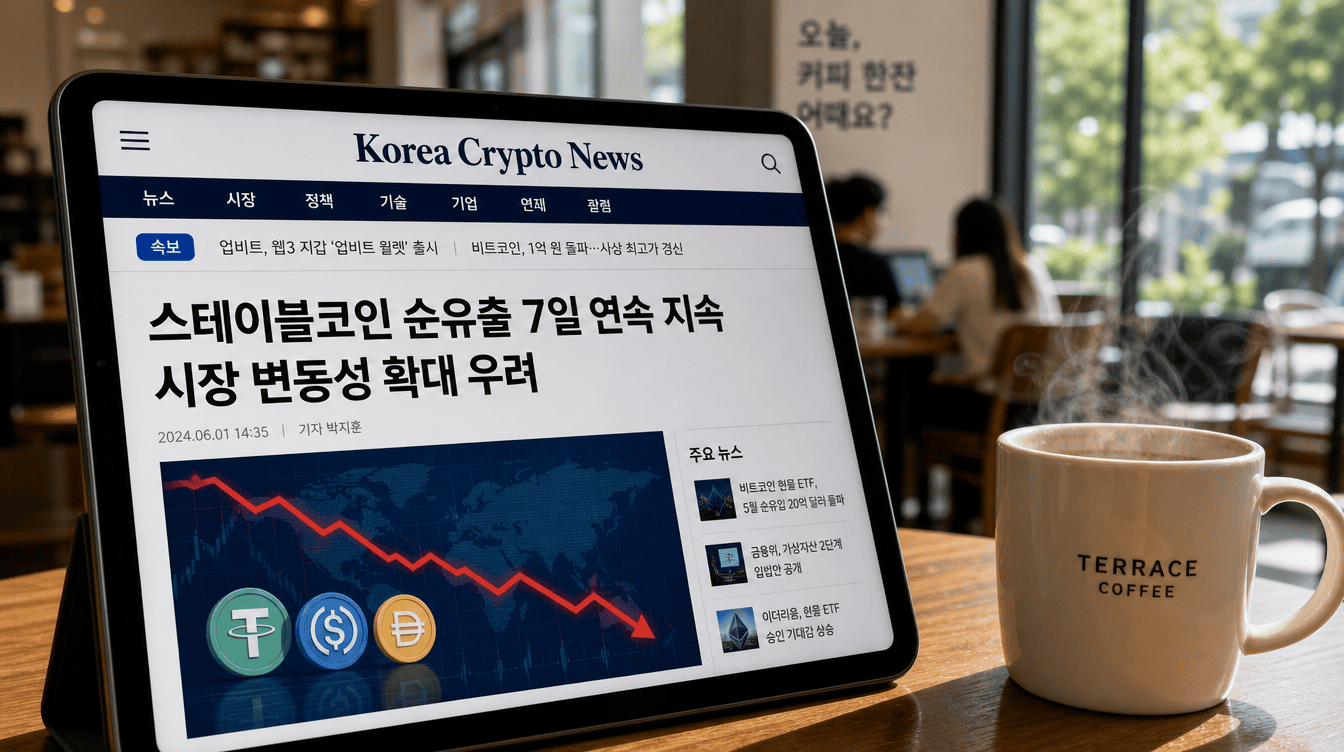
South Korea’s top five cryptocurrency exchanges saw $367 million in net stablecoin outflows in June 2026, extending an 18-month streak that highlights growing demand for crypto products unavailable through domestic platforms.
According to Financial Supervisory Service (FSS) data, the country’s leading won-based exchanges — Upbit, Bithumb, Coinone, Korbit, and Gopax — sent 2.76 trillion won worth of stablecoins to overseas exchanges during the month and received 2.20 trillion won in return. The resulting net outflow was 560.3 billion won, or roughly $367 million.
The June figures marked the 18th straight month of net stablecoin outflows, with the pattern beginning in January 2025. The trend appears less connected to investor panic and more related to the limitations of South Korea’s regulated crypto market.
Rather than exiting digital assets entirely, many Korean traders are moving stablecoins overseas to access derivatives, DeFi services, tokenized assets, and other products that remain restricted on domestic exchanges.
The latest figures come as the global crypto market capitalization stands at approximately $2.22 trillion, down 1.1% over the previous day. Total cryptocurrency trading volume is around $16.9 billion over 24 hours.
Product Restrictions Drive Offshore Stablecoin Transfers
South Korea’s major crypto exchanges operate under the Specific Financial Information Act, which enforces strict anti-money-laundering rules and limits access to various digital asset products, including leveraged trading, decentralized finance platforms, liquid staking services, and many real-world asset (RWA) offerings.
A Korea Times report published on Aug. 2 showed that June’s stablecoin outflows accounted for 77.6% of Korean investors’ net purchases of overseas stocks.
In the second quarter of 2026, Korean investors recorded about 1.69 trillion won in net stablecoin outflows compared with 1.62 trillion won in net foreign stock purchases. The figures suggest stablecoins are increasingly being used as a pathway for investors seeking broader exposure to international markets.
FSS data indicates that several high-demand crypto products remain unavailable through locally licensed platforms. International exchanges such as Binance and Bybit have attracted Korean users by offering products tied to major Korean companies and global assets.
Competition among domestic exchanges has also shifted in the stablecoin segment. Coinone recorded the highest average daily stablecoin trading volume in June at 84.58 billion won, capturing 34.8% of the market after introducing zero-fee USDC trading in October 2025.
Bithumb followed with 75.57 billion won in daily stablecoin volume and a 31.1% market share, while Upbit recorded 73.03 billion won and a 30.1% share, according to FSS figures cited by Korea Times.
The distribution is significantly different from January 2025, when Upbit held 53.5% of the stablecoin market, Bithumb controlled 42.5%, and Coinone accounted for only 1.8%.
However, the shift in domestic market share has not changed the broader outflow trend. Coinone’s zero-fee campaign appears to have moved trading activity between local exchanges rather than preventing capital from leaving the country.
Upbit remains the dominant player in overall crypto trading volume, with CoinGecko data cited by Korea Times showing the exchange accounted for roughly 60% of average daily trading activity in June, while Bithumb represented 32%.
Still, stablecoins are increasingly functioning as a transfer tool for moving funds to overseas platforms rather than simply serving as domestic trading assets.
Calls Increase for Crypto Regulatory Updates
The continued movement of stablecoins abroad has prompted calls for changes to South Korea’s crypto regulations. Rep. Lee, according to Korea Times, urged the government to improve investor protection measures and strengthen oversight frameworks.
Lawmakers have expressed concerns that Korean retail investors are accessing highly leveraged products through overseas exchanges that do not fall under domestic protections. They have also raised questions about monitoring stablecoin transactions that move outside traditional financial systems.
Policy discussions have included possible frameworks for won-based stablecoins, security token offerings, and institutional custody solutions, although no clear timeline for new legislation has been provided.
The ongoing challenge appears to be linked to the limited range of products offered by regulated domestic exchanges rather than restrictions on capital movement.
Unless South Korean platforms expand their offerings to compete with global exchanges and decentralized networks, stablecoins are likely to continue flowing offshore. The June data suggests this has become a long-term structural trend within the country’s crypto market.