cpeditor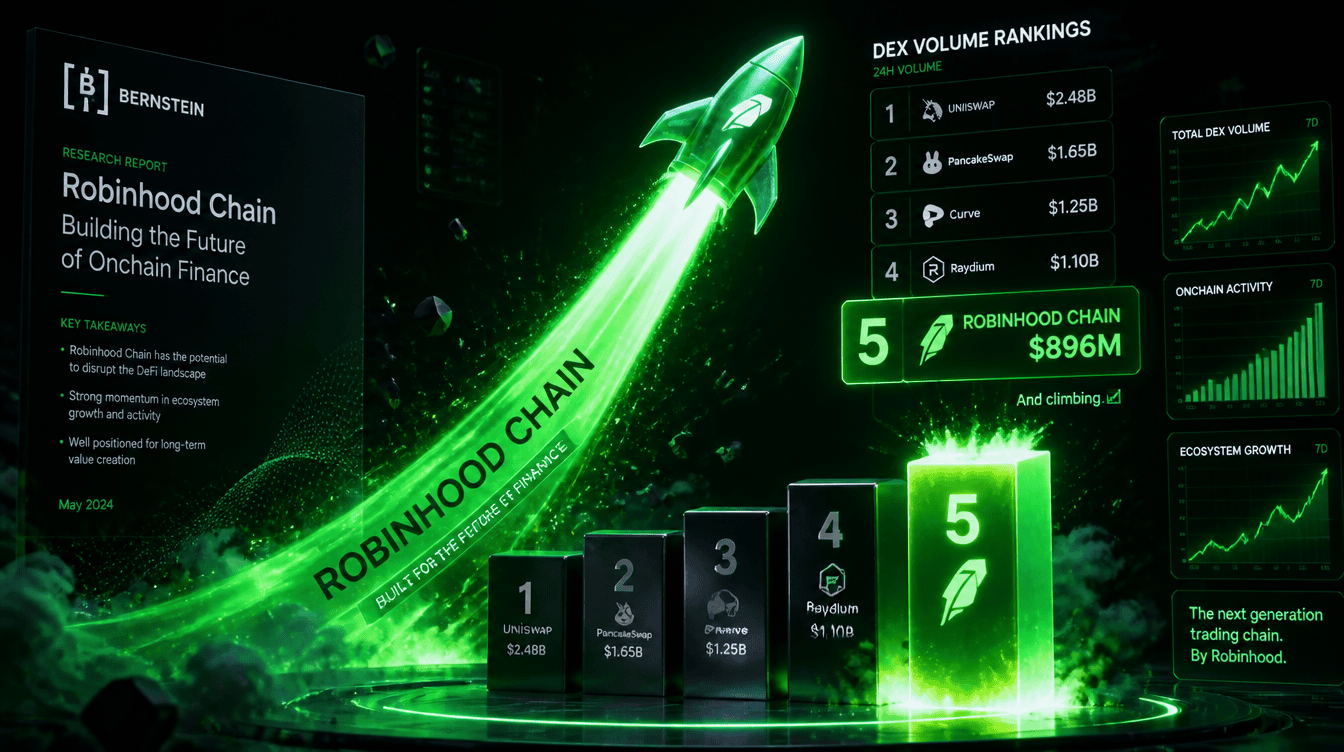
Robinhood’s newly launched blockchain has quickly become one of the most active networks in decentralized trading, signaling strong early adoption for the company’s push into tokenized financial assets, according to Bernstein.
In its latest research note, Bernstein said Robinhood Chain has delivered a strong start since launch, rapidly gaining traction among decentralized exchange users and supporting Robinhood’s broader vision of expanding tokenized investment products.
Within its first week after launching the mainnet on July 1, Robinhood Chain recorded approximately $3.1 billion in decentralized exchange trading volume, placing it among the top five blockchain networks by DEX activity. The platform has also attracted over 65,000 users, with wallets holding nearly $13 million in tokenized equities and around $300 million in stablecoins.
Bernstein analysts led by Gautam Chhugani said the early momentum highlights the increasing overlap between tokenized real-world assets and decentralized finance. They added that market participants are continuing to explore new frameworks for bringing regulated assets onto blockchain networks.
Robinhood Chain launched as an Ethereum Layer 2 network built on Arbitrum infrastructure, specifically designed for tokenized assets and DeFi applications. The network supports Robinhood’s tokenized stock platform, allowing users to trade assets continuously, maintain self-custody, and access on-chain financial tools such as lending and collateral services.
The blockchain also strengthens Robinhood’s crypto strategy by combining tokenized securities, decentralized lending, and perpetual futures within an Ethereum scaling ecosystem, Bernstein said.
While early trading activity has been influenced by memecoin speculation, analysts expect the network’s long-term growth to be driven by tokenized real-world assets, including stocks and commodities, along with derivatives markets.
Bernstein also emphasized Robinhood’s ecosystem partnerships with companies such as Uniswap, Morpho, Lighter, Chainlink, and BitGo. These integrations are expected to improve liquidity and expand the practical applications of tokenized assets.
The launch comes as demand for real-world asset tokenization continues to accelerate across the crypto industry. Bernstein reported that the sector has expanded beyond $51 billion, growing about 50% so far this year, while tokenized equities have increased roughly 170% to approximately $1.9 billion.
Bernstein remains bullish on Robinhood’s outlook, maintaining an outperform rating with a $130 price target. Robinhood shares were trading slightly lower in early Monday activity, falling 0.6% to about $111.35.